

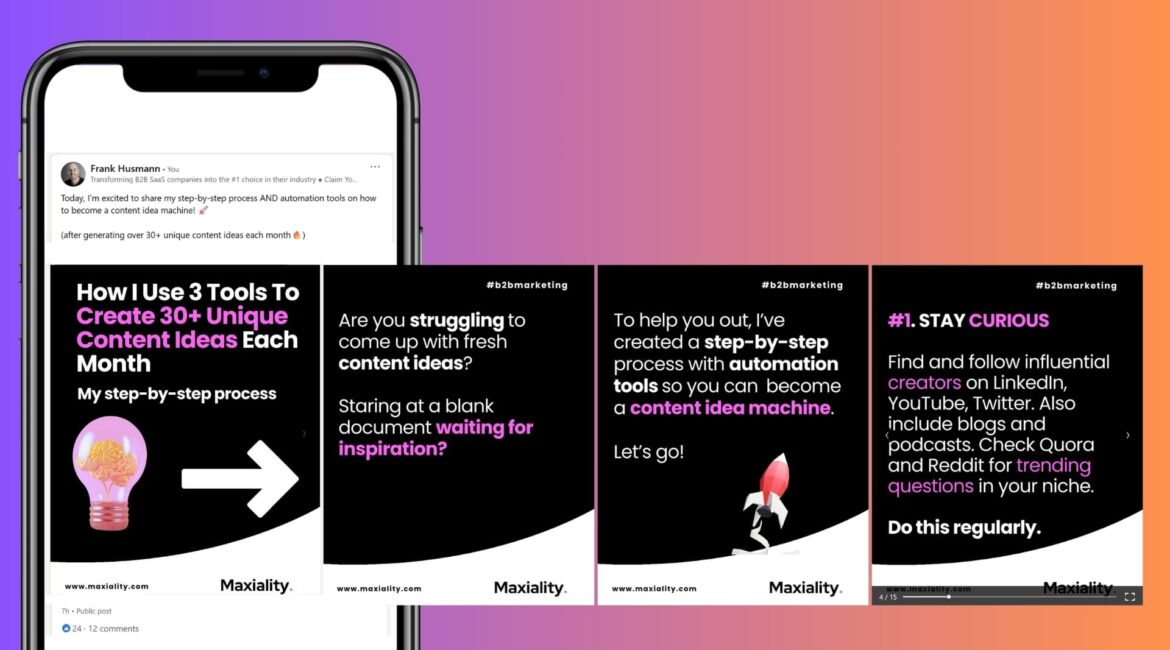
Most LinkedIn carousels get made for the wrong reason. Someone reads that carousels drive more engagement, opens Canva, adds some bullets and a gradient background, and publishes it. The post gets 40 swipes and 12 likes, mostly from other content marketers doing the same thing.
That is not the outcome you are looking for.
A carousel that works for a does one thing: it makes your ICP recognize you as someone who understands their problem better than anyone else in their feed. That happens through content structure, not through design choices.
Contents
What Are LinkedIn Carousels?
LinkedIn carousels are a series of swipeable images or cards that allow you to share multiple pieces of content within a single post. This feature is an excellent way to showcase a step-by-step process, highlight key points, or narrate a compelling story.
The format does two things other post types cannot:
1. It forces you to structure your thinking
Writing a carousel means deciding: what is slide 1, what is slide 2, what is the payoff. That pressure removes the filler that makes regular text posts vague. If you cannot fill ten slides with substance on a topic, you do not have a post yet.
2. It signals investment
A carousel takes more effort than a text post. Readers interpret that effort as evidence you have something real to say. The bar for dismissing it is higher.
What it does not do is make weak content strong. A carousel full of generic advice is just generic advice with better formatting.
Benefits of Using LinkedIn Carousel Posts
LinkedIn carousel posts offer several benefits that can help you increase your visibility, engagement, and credibility on the platform. Here are some of the benefits of using LinkedIn carousel posts:
- Increased visibility and engagement: Carousel posts tend to generate higher engagement rates compared to single-image posts, as they encourage users to swipe through and consume more content. Moreover, the algorithm often rewards posts with higher engagement, which can help you reach a larger audience.
- Ability to share more information: Carousel posts allow you to share much more information than typical LinkedIn posts. You can add as many pages as you’d like to a carousel, providing more information about your brand or products to your customers.
- Showcase your expertise: By consistently delivering valuable content through carousels, you can enhance your credibility and attract the attention of potential clients, collaborators, or employers. You can share insights, industry trends, or offer practical tips, positioning yourself as a thought leader in your field. This is great if your are doing authority marketing.
- Interactive and eye-catching: Carousels are interactive and have eye-catching graphic designs, making them stand out on the newsfeed. This can help you grab the attention of your audience and increase your reach.
Anatomy of the Perfect LinkedIn Carousel
The contents of a LinkedIn carousel consists of the following slides:
- The cover slide
- A second slide that amplifies the cover
- The solution slide
- Proof
- Slides about the steps and examples of the solution
- A call to action slide
The most viral LinkedIn carousels consist of 10 to 30 pages with about 20 to 30 words per page.
I’m going to break down each of the slides for your below using a carousel for our LinkedIn marketing agency:
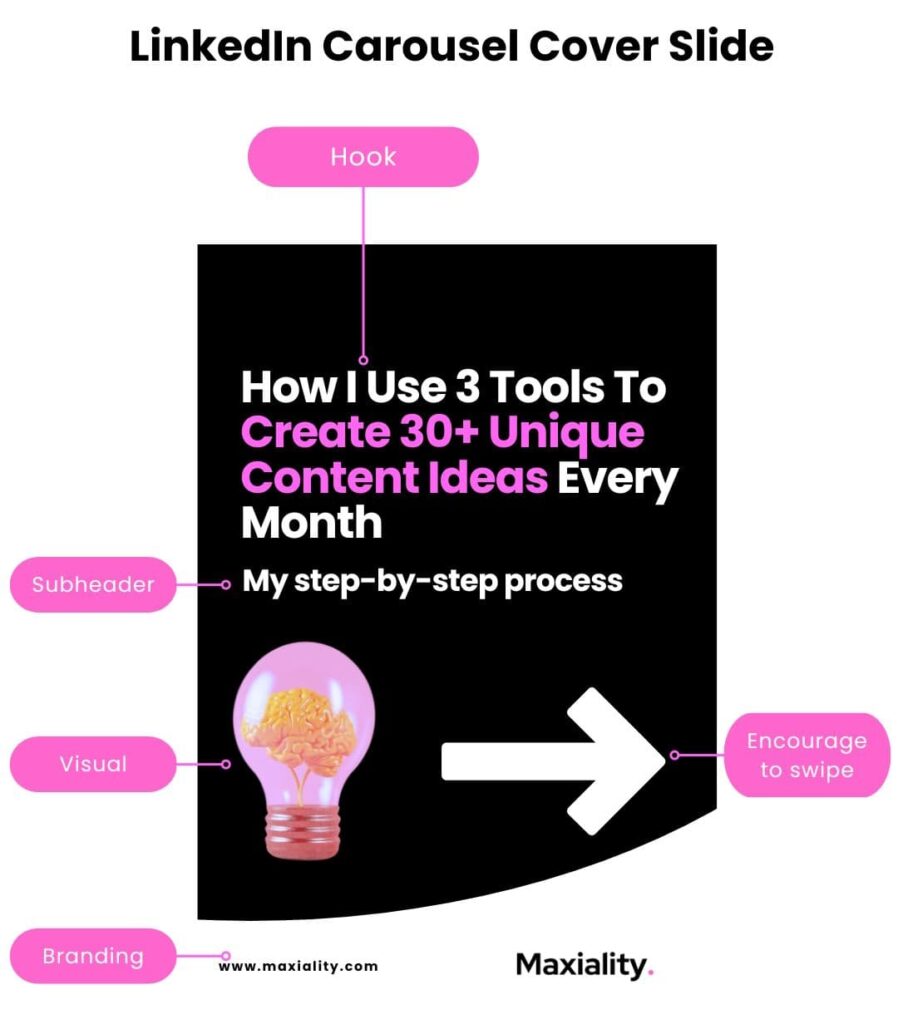
1. The cover slide
- For the subject: go deep on a micro-topic. And write about that one topic, make sure you don’t overwhelm your audience.
- Use a hook and/or include numbers for the title. You can use this format: action + goal = result or add “How I…”. This will make it more authentic.
- Add a subheading that compliments the hooks. You can use this to add a promise and/or a result of the hook.
- Add a visual related to the post. It can be proof, a screenshot or a great stock photo.
2. The second slide that amplifies the cover
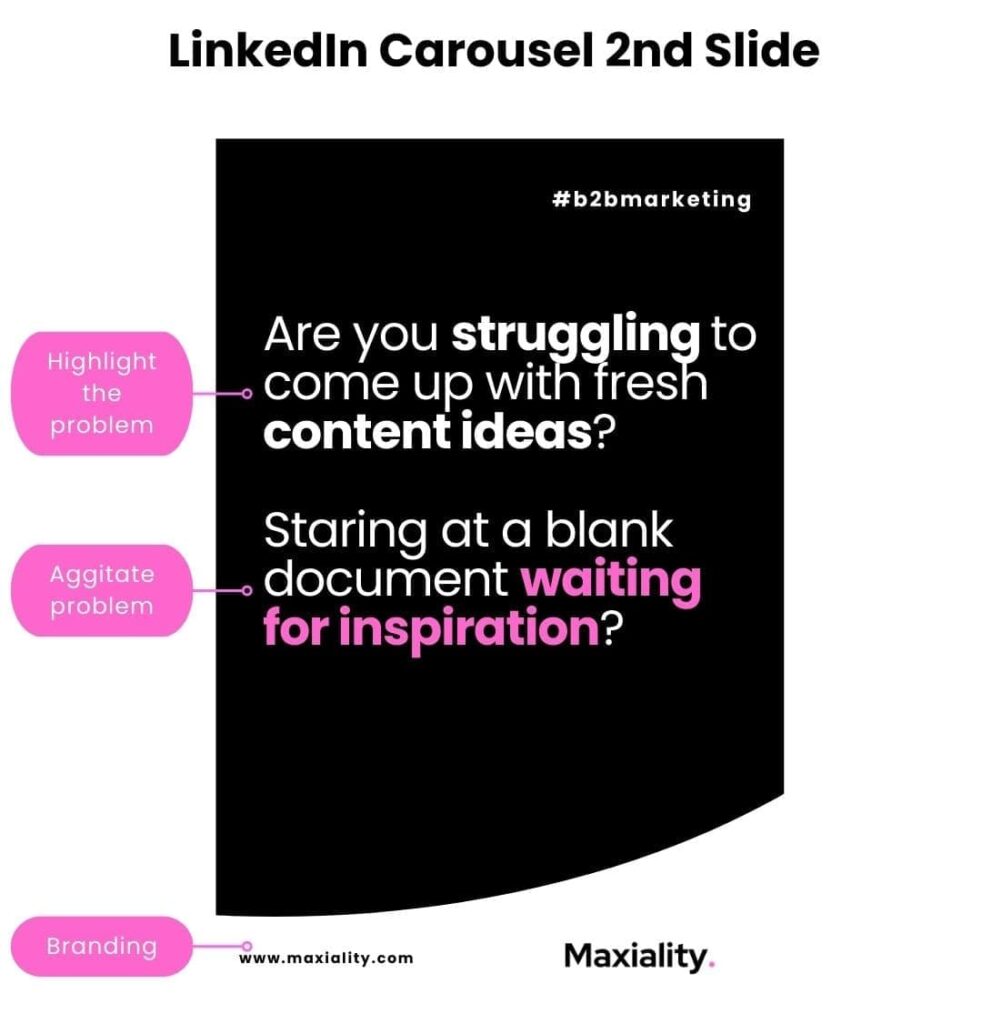
- Use a different hook and pique the curiosity of the audience
- Give more context
- Highlight the problem or goal of the carousel
3. The solution slide
This one is easy: explain your solution / tips without telling the steps, do that later.
4. The proof slide
Show (social) proof that your solution really works by:
- Adding screenshots of stats or metrics
- Adding screenshots of (client) results
5. Steps on how to deliver the solution
In the next slides, make sure you deliver on what your hook promises:
- Make it easy to read, digest and implement
- Use unique images
- Use examples if you can
6. Call To Action Slide
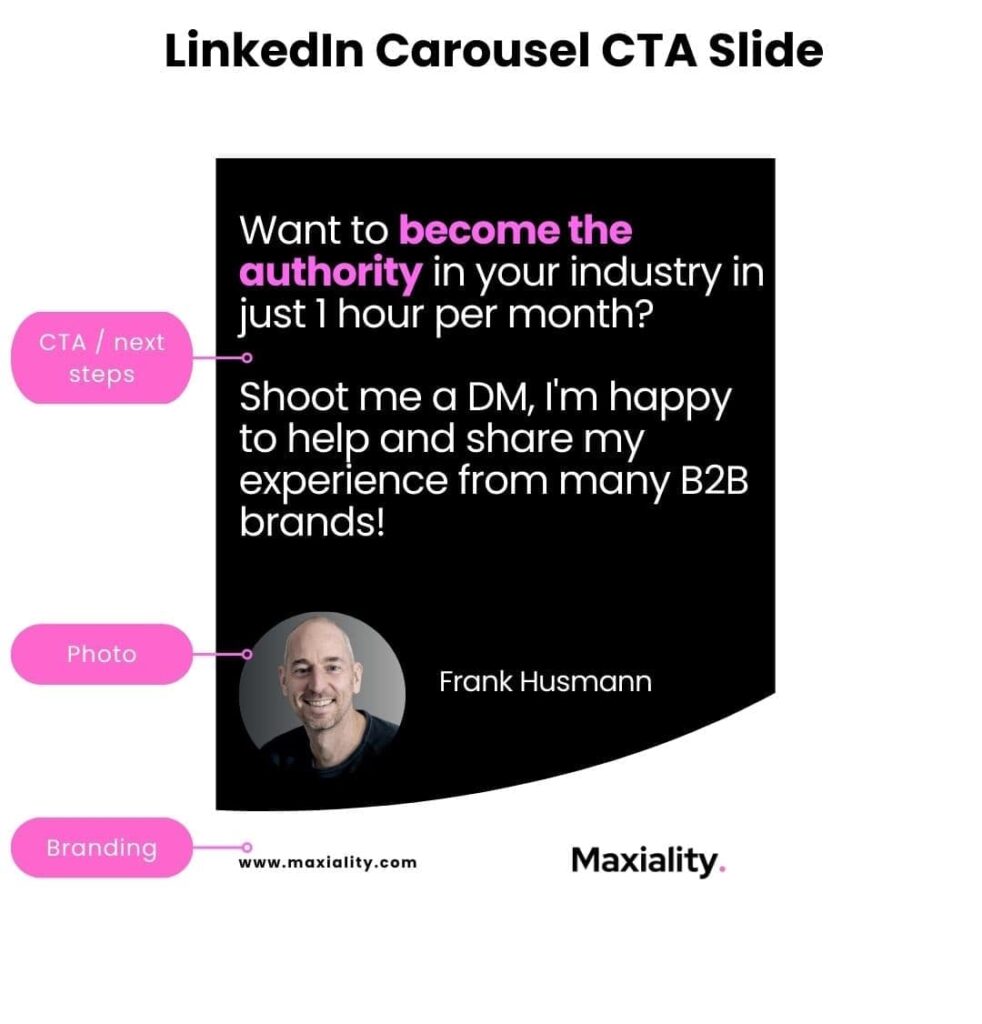
Not five CTAs. One. Either follow for more content like this, or a specific action tied directly to what you just taught. A headshot builds connection. Keep the slide clean and show the reader what the next steps could be if they want to know more by adding the following:
- Clear ‘follow’ CTA or a benefit driven CTA to an offer
- Clear headshot to show personality & build connection
5 Steps To Create a LinkedIn Carousel
Now that you know what the anatomy of the perfect LinkedIn carousel should look like, you can start creating one. Here’s a step-by-step guide on how to create a LinkedIn carousel post using my favorite tool Canva:
Step 1: Create a Canva account
Canva is a popular, free design tool that allows you to create visually appealing images for your LinkedIn carousel post. Sign up for a Canva account if you don’t have one already.
Step 2: Select your image size
Choose the appropriate image size for your carousel post. You can either use a portrait post size of 1080 x 1350 pixels or a squared size of 1080 x 1080 pixels.
Step 3: Design your carousel
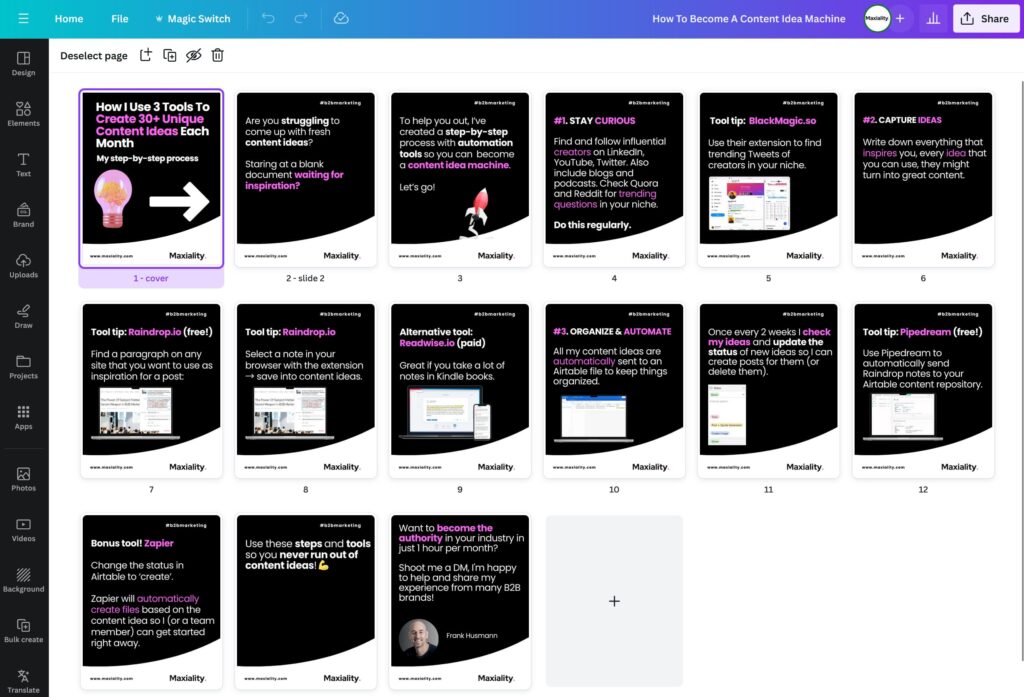
You can start by using a template to create your carousel or build one from scratch. Add multiple slides to your project. You can use text, icons, and other design elements to make your carousel visually appealing.
Step 4: Save your creation as a PDF
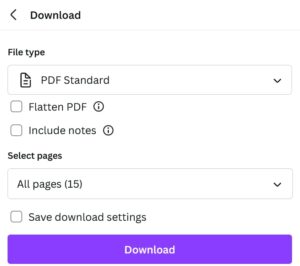
LinkedIn allows you to post images, but they need to be in document form for carousel posts. To save your images as a PDF, go to Canva’s “Download” option and choose “PDF” as the file format.
Step 5: Post your carousel on LinkedIn
- Go to your LinkedIn page and click the “Start a post” button.
- Click the “document” icon on your homepage feed or select the document sharing button on the “Create a post” window.
- Click the “Choose file” option and select the PDF file you saved in Canva.
- Post your carousel on LinkedIn as a document.

Bonus Tips for Creating a Successful LinkedIn Carousel Post
- Optimize navigation by adding arrows or ‘breadcrumbs’ (e.g. slide [topic] 3/5)
- Use more visuals to limit the amount of words. It’s not an essay! 🙂
- Use statistics and infographics to make your content more engaging.
- Use easy to read fonts and contrasting colors to make it stand out in the feed.
- Use consistent branding colors & visuals.
- Optimize for mobile viewing. It’s crucial to optimize your carousel for smaller screens. Ensure that your visuals and text are easily readable on mobile devices.
By following these steps and tips, you can create an engaging and visually appealing LinkedIn carousel post that will help you stand out on the platform and connect with your audience.
Tools to Create LinkedIn Carousels with Templates:
Here are my recommended do it yourself tools for creating LinkedIn carousels. Both tools are free:
Both Canva and Figma have great templates for LinkedIn carousels to get you started. You can find the Canva carousel templates inside the app and the Figma carousel templates in the Figma community.
Other carousel creation tools I recommend:
- AICarousels – this tool will help you create a carousel using AI
- Contentdrips has many carousel templates for LinkedIn.
The Mistakes That Make Carousels Invisible
Starting with the solution, not the problem. Slide 1 says “Here are 5 ways to improve your sales process.” Nobody has swiped yet. They do not know if this is for them. Start with the situation or the tension. Then the solution.
Using it as a product brochure. “Our platform does X. It also does Y. Here are our pricing tiers.” That is not a carousel. It is a PDF nobody asked for. Carousels that push a product without teaching something earn nothing and train your audience to skip your posts.
Designing before writing. Founders who spend three hours in Canva and twenty minutes on the copy have their priorities inverted. Beautiful slides with thin content perform worse than plain slides with sharp content. Write every slide as text first. Design around it afterward.
Making every slide the same length. One slide might need three words. Another might need eight. Uniform slide density signals that you filled space rather than said something. Let each point take the space it actually needs.
Conclusion
Carousels are not a format trick. They are a teaching format.
The people who build real authority through carousels use the format to share structured thinking developed from running their business, not from aggregating advice found elsewhere. That is what makes someone save a post, share it, or send it to a colleague.
Our research across 3,000+ LinkedIn posts from 100+ SaaS founders found that top-performing founders publish 42% thought leadership content. Average founders publish 8%. The gap is not design skill or posting frequency. It is the willingness to take a clear position and teach from real experience.
A well-built carousel forces you to do exactly that.