

Most B2B SaaS founders close their first deals on relationship and instinct. They know their product, they’re good in a room, and they find a way to win. The problem is that this doesn’t scale.
When every deal depends on the founder’s personal judgment about whether a prospect is serious, pipeline becomes unpredictable. Some deals take three months. Some take three weeks. You can’t tell the difference until you’re already three months in.
The SPICED framework is a qualification method built specifically for B2B SaaS. It gives you a consistent way to evaluate every deal, not just the ones that feel right.
What is the SPICED framework?
SPICED was developed by Winning by Design, a revenue consultancy focused on recurring revenue businesses. It stands for: Situation, Pain, Impact, Critical Event, Economic Buyer, Decision.
Unlike BANT (Budget, Authority, Need, Timeline), which was designed for one-time sales and focuses on what the seller needs to know, SPICED is built around what the buyer is experiencing. The difference matters. BANT helps you qualify whether someone can buy. SPICED helps you understand whether they need to buy, and why now.
For B2B SaaS founders running high-ticket sales with long cycles, that distinction is the difference between a pipeline full of real opportunities and a pipeline full of conversations that feel promising but go nowhere.
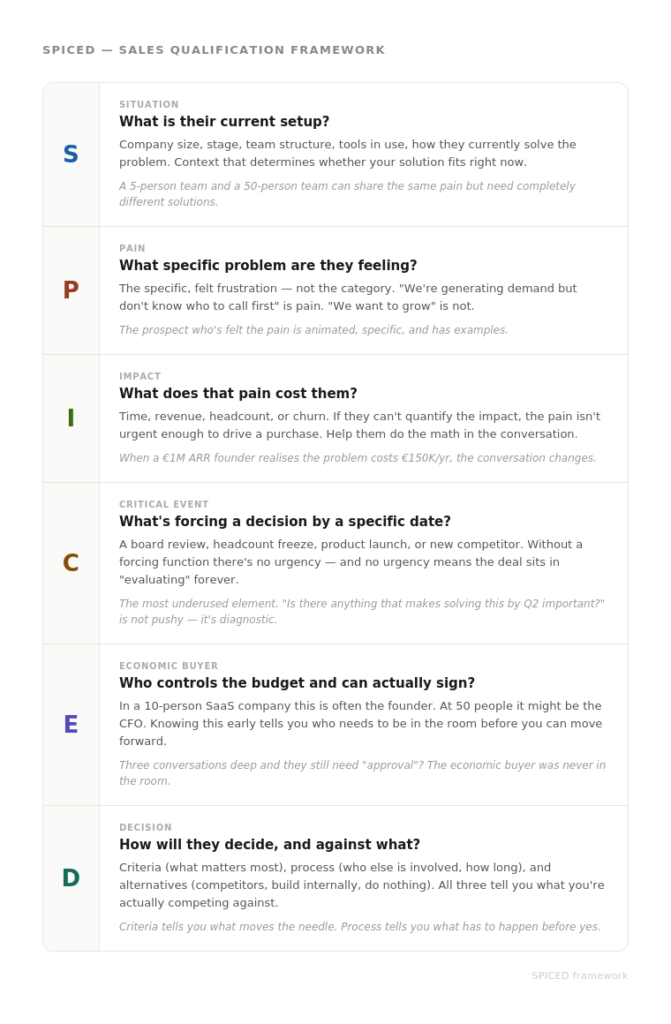
Breaking down each element
Situation
What is the prospect’s current setup? Company size, stage, team structure, the tools they’re using, how they’re currently solving the problem you solve.
This isn’t small talk. It’s context that determines whether your solution makes sense for them right now. A 5-person team and a 50-person team may have the same pain, but completely different situations. The fit question comes before everything else.
Pain
What specific problem are they experiencing? The specific, felt frustration, not the category problem. “We’re generating demand but our sales team doesn’t know who to call first” is pain. “We want to grow” is not.
Founders who’ve been through enough sales conversations can hear the difference. The prospect who’s felt the pain is animated, specific, and has examples. The one who hasn’t is describing a category they read about.
Impact
What does that pain cost them in time, revenue, headcount, or churn? If the prospect can’t quantify the impact, the pain isn’t urgent enough to drive a purchase decision.
This is where most B2B SaaS deals stall. A prospect acknowledges the problem but hasn’t done the math on what it’s costing them. Your job is to help them do that math in the conversation. When a founder at a €1M ARR company realizes the problem is responsible for €150K in lost annual revenue, the conversation changes.
Critical Event
What’s forcing a decision by a specific date? A board review, a headcount freeze, a product launch, a new competitive entrant. Without a forcing function, there’s no urgency. And no urgency means the deal sits in “we’re evaluating” forever.
This is the most underused element of SPICED. Founders are often reluctant to push on this because it feels aggressive. But asking “is there anything that makes solving this by Q2 particularly important?” is not pushy. It’s the question that separates a real deal from a polite conversation.
Economic Buyer
Who controls the budget and can actually sign? In a 10-person SaaS company, this is often the founder. In a 50-person company, it might be the CFO or the CEO depending on contract size. Knowing this early tells you who needs to be in the room before you can move forward.
If you’re three conversations deep and the person you’re talking to still needs to “get approval,” the economic buyer was never in the room. That’s a recoverable situation, but only if you address it directly.
Decision
How will they make the decision, and what are they evaluating against? You need to know the criteria (what matters most to them), the process (who else is involved, how long it typically takes), and the alternatives (are they looking at competitors, building internally, or doing nothing?).
Knowing their decision criteria lets you speak to what actually moves the needle. Knowing the process tells you what has to happen before they can say yes. Knowing the alternatives tells you what you’re actually competing against.
Why SPICED works better than BANT for B2B SaaS
BANT was developed by IBM in the 1950s for high-volume enterprise sales. It asks: do they have the budget, the authority, the need, and the right timeline? These are useful checks, but they’re binary and they’re about the seller’s requirements, not the buyer’s situation.
SPICED is diagnostic. It forces a real conversation about what’s happening in the buyer’s world, what it’s costing them, and what’s driving the timeline. Done well, the prospect leaves feeling understood rather than interrogated, and you leave with data you can actually forecast from.
Research from Gartner consistently shows that B2B buyers who feel their specific situation is understood are significantly more likely to complete a purchase and less likely to regret it. For high-ticket B2B SaaS, where average contract values often exceed €20K, post-purchase regret translates directly into churn.
How founder authority accelerates SPICED
The quality of your SPICED data depends heavily on how much trust existed before the first conversation.
A prospect who has followed your thinking for months already has answers to Situation and Pain before they get on a call. They’ve self-qualified because your content has described their world accurately. They’re not arriving to learn about you, they’re arriving to confirm what they’ve already decided.
Tom van Eijmeren, founder at ClockAssist, made this concrete: “The intent signals from your campaigns give us exactly the insights we need to approach the right accounting firms. This saves us time and helps us gain new customers.” That’s SPICED data arriving before the sales conversation even starts.
The same dynamic appeared at StoryChief. Within the first ten days of running LinkedIn video content, Robert (CRO) had two high-quality demo requests directly attributable to the content. Those prospects had already answered Situation, Pain, and Impact in their own heads before booking the demo.
When you build authority consistently, your SPICED conversations get shorter. You spend less time establishing context and more time confirming what the prospect already believes.
FAQ
Is SPICED only useful for enterprise SaaS sales?
No. SPICED is particularly well-suited for B2B SaaS in the €500K to €5M ARR range, where deals are high-ticket but the sales team is small. The value isn’t the framework itself, it’s the discipline of asking the same questions every time so you can compare deals and forecast accurately. A five-person team benefits from that consistency more than a fifty-person team with a dedicated sales ops function.
What’s the difference between SPICED and MEDDIC?
MEDDIC (Metrics, Economic Buyer, Decision Criteria, Decision Process, Identify Pain, Champion) covers similar ground but is heavier and more enterprise-focused. SPICED treats Critical Event as a first-class element, which makes it more useful for SaaS where urgency and timing often determine whether a deal closes this quarter or gets deferred indefinitely. MEDDIC also assumes a champion inside the buying organization, which isn’t always present in SMB or mid-market deals.
How do I get prospects to answer these questions honestly?
The framework only works if the conversation feels like a diagnostic, not an interrogation. Lead with your own insight: “Most founders I talk to at your stage are dealing with X. Is that showing up for you?” A prospect who trusts your judgment will answer honestly. A prospect who thinks you’re running a sales script will give you polished, non-committal answers. This is why founder authority matters: it changes the quality of the conversation before the conversation starts.
Conclusion
SPICED gives B2B SaaS founders a structured way to evaluate every deal with the same lens, forecast pipeline honestly, and stop spending months on conversations that were never going to close.
Most founders apply it for two calls, then revert to instinct the moment a deal feels exciting. That’s when the bad forecasts happen. Apply it to every deal, especially the ones that feel obvious, and your pipeline starts reflecting reality rather than optimism.
If you want to connect your qualification process to your demand generation so prospects arrive pre-qualified, that’s the conversation we have with founders regularly.