

Devin Reed asked LinkedIn one question: what is your secret for creating banger webinars? He ruled out “we do polls” in advance. more than 100 people answered. The most-cited factor wasn’t the content, the speaker or the format. It was the chat: 20 of the 74 usable answers.
I read and coded every answer. I grouped 74 usable answers into themes, ranked by how many people raised each one, and then checked against 2026 benchmark data from four webinar platforms: Goldcast, Livestorm, ON24 and Contrast. The first two publish how many sessions they analysed: roughly 60,000 between them.
The data agrees: the chat is where hosts lose. In Livestorm’s data, chat is switched on in 90% of sessions, and in a typical 60 to 75 minute session only about 15% of attendees take part. So what separates a session people remember? That’s what the rest of this article checks, theme by theme, against what hosts believe.
Contents
How I analysed the 100+ answers
I tagged every answer to one or more themes. An answer that covered three topics counts three times, which is why the theme totals add up to more than 74.
The people answering are mostly B2B marketers, with founders, webinar producers and a few self-described serial attendees mixed in.
I ranked by the number of people raising a theme, not by likes. Likes are a bad signal in this thread: 57 of the 100+ answers got none, a single answer holds 50 of the 169 total, and the jokes collected 27.
One limit applies to everything below. These are opinions, not measurements. Only three of the 100+ people cite numbers of their own. So each theme is set against benchmark data, and where the data is missing or points the other way, I say so. The benchmarks have a limit of their own: all four come from platform vendors describing their own customers, and their definitions differ.
The ranking
Here’s how the 74 usable answers broke down by theme, one answer can count toward more than one:
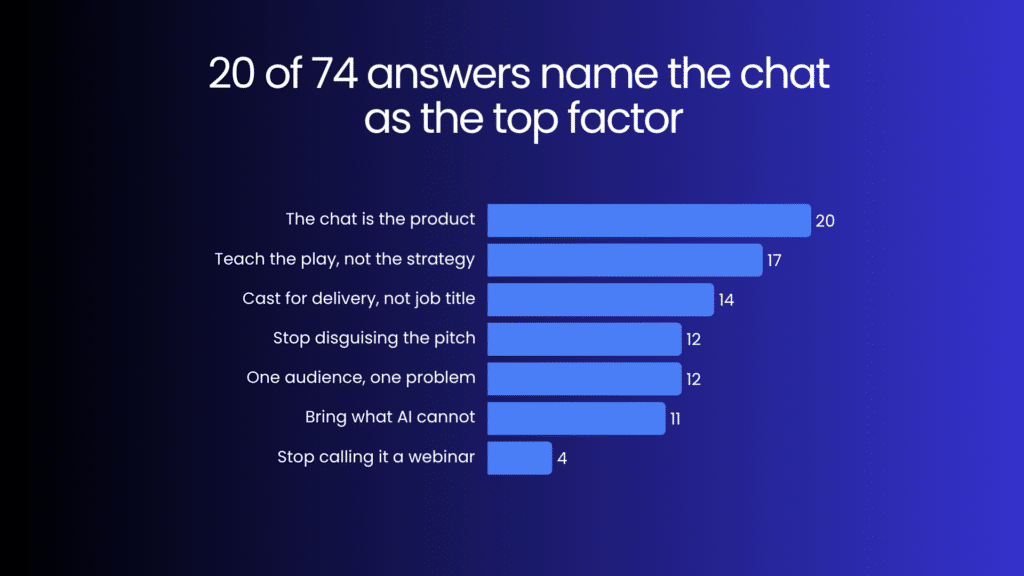
Six themes were each raised by at least 11 people, and after that the counts fall away quickly. The rest of this article follows that order, with one exception that is flagged where it appears.
1. The chat is the product
20 of 74 answers. 63 reactions, more than twice any other theme.
The most-liked answer says to curate the chat as much as you curate the content. Its comparison is a house party: before people decide to come, they want to know who else will be there.
Others got specific about how. The host should talk to the chat out loud for the entire session, not type replies into a Q&A box. A webinar producer lists the moves: call people by name, react to a specific comment, bring a good one back to the presenter and let it change the conversation. Two teams put colleagues in the chat to share resources and answer questions while the host presents.
What the data says. Livestorm’s 2026 benchmark covers 33,786 sessions. Chat is used in 90% of them. In sessions of 60 to 75 minutes, attendees send 0.58 chat messages each and 15.4% take part actively. ON24 reports 1.8 interactions per attendee across its platform, counting polls, downloads and reactions.
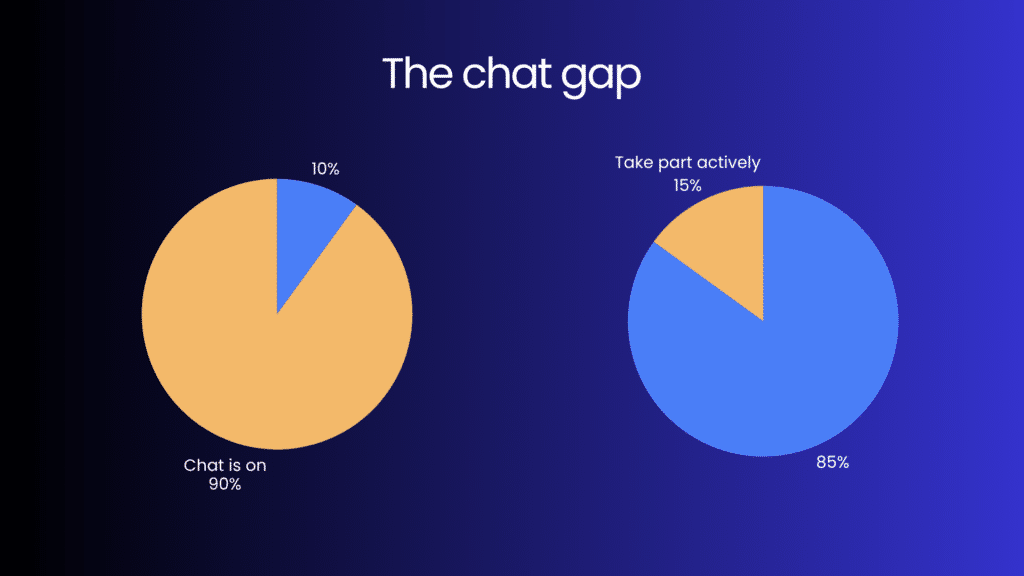
The feature is on almost everywhere and almost nobody uses it. The tooling is already in place, so the gap is in the hosting.
Do this:
- Give the host one standing instruction: address the chat by name, out loud, every few minutes.
- Put a second person in the chat whose only job is the chat.
- Invite the attendees you want in the room directly, the way you would invite speakers.
- Open with a question whose answers you will use in the session.
Curating the room is the first move. What happens once people are in the room is the second, and it’s where the content itself gets judged.
2. Teach the play, not the strategy
17 of 74 answers.
One answer speaks for the viewer: sessions that stay at strategy level are a letdown. People want the workflows and the examples, and to leave with an action plan. Hosts say the same from their side: tactical beats high-level, and the closer you get to walking through one play step by step, the better.
Several people push this to its logical end and call for a workshop. Attendees follow along and do the thing while you do it. One answer offers a usable test: is the content something an attendee wants to write down and implement the moment the session ends? A PDF download does not pass.
What the data says. No benchmark measures how tactical a session is. What they do measure is how long you have. On Livestorm the average viewer watches 26 minutes of a 68-minute session, about 38%. Contrast, working from more than a million registrants, puts the average drop-off point at minute 22 and the completion rate for a 60-minute session at 37%. ON24 is the outlier at 49 minutes of average engagement, on a sample it does not publish.
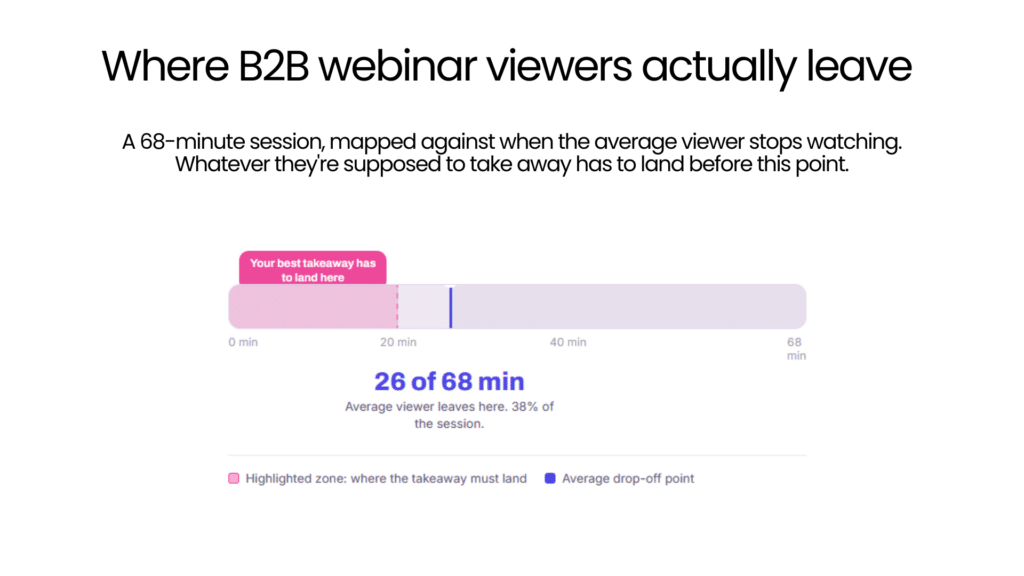
The average viewer leaves before the halfway mark. Whatever they are supposed to take away has to be on screen in the first 20 minutes.
Do this:
- Share your screen and build one thing live, start to finish.
- Limit the session to three or four takeaways that each work on their own.
- Put the most usable one first, not last.
- Cut the product tour. One commenter put it bluntly: tool demos are a snooze, tell me the hacks.
None of that lands if the wrong person is delivering it. Who’s on screen turned out to matter almost as much as what they’re saying.
3. Cast for delivery, not job title
14 of 74 answers.
The rule that opens one of the longest answers: choose guests for how well they present and hold a conversation, not for their title or company logo. Another answer goes further and treats a C-level or VP guest as a warning that an infomercial is coming. The most useful guests, on that view, are engineers and others at execution level.
The host gets equal attention. The host makes or breaks the session, and a monotone one breaks it. One rule of thumb: it takes 500% energy to land as 100% through a screen.
What the data says. Very little, and it is worth being plain about that. Goldcast’s 2026 report counts three to four speakers on the average webinar. Nobody benchmarks whether they were any good.
One rough sum is still useful. Three to four speakers sharing the 26 minutes an average viewer stays leaves each of them about seven minutes of real attention. That figure mixes two datasets, so treat it as an illustration. It does explain why people want introductions cut to one or two sentences.
Do this:
- Watch a recording of a guest before you book them.
- Prefer the person who did the work over the person who signed it off.
- Brief the host to moderate: cut in when someone runs long.
- Ban reading from slides. Take them off screen when they add nothing.
Get the chat, the content and the cast right, and attendees still bail the moment they smell a pitch coming. That was the next most common complaint in the numbers.
4. Stop disguising the pitch
12 of 74 answers.
The complaint is specific. One answer names the pattern: teach a generic roadmap in impressive words, then pitch the implementation. Another asks for useful information and not a sales pitch dressed up as research. A third wants the company overview gone, and points out that leaving it out gives you a reason to follow up.
Nobody objects to selling as such. One answer allows an offer as long as the three or four takeaways stand without it. Another, citing more than 600 webinars, keeps sales out of the content entirely and makes one session-specific offer at the end.
What the data says. Attendees do act on offers when they are presented as offers. ON24’s 2026 benchmark reports demo bookings from webinars up 73% year over year, clicks on calls to action up 49% per attendee, and meetings booked during a webinar up fourfold. ON24 does not publish the sample behind these figures, so read them as direction, not as a rate you can plan on.
The two are compatible. The data shows that a clear offer gets acted on. The practitioners object to a pitch posing as teaching, and no benchmark measures what that costs.
Do this:
- Delete the company overview slide.
- Check each takeaway: does it work for someone who never buys from you?
- Make one offer, at the end, tied to what the session covered.
5. One audience, one problem
12 of 74 answers, and only 3 reactions between them.
This is the least applauded theme in the top tier, and one answer calls it the core that everything else follows from. The asks are consistent: content specific to the ICP, in the detail that matters to them. A topic framed as a problem to solve. Niche topics and smaller audiences. One answer names the failure mode: a mismatch between what the promotion promised and what the session delivers.
What the data says. Smaller rooms hold together better. In Contrast’s data, webinars with fewer than 100 registrants average a higher live attendance rate than larger ones: sessions with 100 to 1,000 registrants average 44% and those above 1,000 average 37%. Goldcast’s 2026 average is 251 registrants and 102 attendees, a 40% attendance rate.
This is a correlation, not proof that narrowing your topic raises attendance. What it does mean is that a small registration number is a poor reason to broaden one. Write the topic as one problem one type of buyer has this quarter, state in the promotion exactly what will be covered, and deliver that. Then judge the session on who came and what they did, not on the registration count.
Narrow the audience and the content, and there’s still one thing left that a tight brief and a good speaker can’t fake on their own.
6. Bring what AI cannot
11 of 74 answers.
Two people make the same argument independently. The first: AI has made high-level advice available to everyone, and what it does not have is how a particular idea worked, or flopped, for you. The second: now that information is easy to get, what lands is owned research, wrapped in a strong point of view.
A third describes the practice: lead with what you have done yourself, walk through how, and do not skip the failures or what you changed afterwards. People are easier to trust when they can explain where their own advice went wrong. One answer compresses it into a line: a session should not only teach, it should prove something.
What the data says. None of the platform benchmarks measure originality. The nearest evidence is older and about thought leadership in general. In an Edelman and LinkedIn survey of 1,300 business decision-makers, published in 2017, 56% said that most of the time they gain no valuable insight from the thought leadership they consume, and 45% said weak material had lowered their respect for the company behind it.
That predates generative AI. The practitioners’ argument is that generic material has become far easier to produce since.
Build the session around one thing you ran yourself, with the numbers, and include what failed and what you changed afterwards. If it’s based on a report you already published, add the reading that isn’t in the report.
The six themes above are about what happens once someone has registered. The last one is about whether they register at all.
7. Stop calling it a webinar
4 of 74 answers.
On the count alone this theme sits near the bottom. I have moved it up because it is the cheapest change on the list and the only one with a direct test behind it. The data is also more mixed than its supporters suggest, so it gets a closer look.
The alternatives people use: sessions, web breakouts, mini summits, livestream, fireside. One answer calls the word cursed. Another adds a further step, which is to create a series and brand it, and attaches a caveat: all of this assumes the session is full of useful material to begin with.
What the data says, for. Goldcast’s first benchmark report, published in 2023 and covering 900 webinars from 100 B2B brands, found a 50% drop in registrations when the word “webinar” appeared in the event name. More recently, Exit Five’s newsletter relayed an A/B test from Jay Schwedelson’s team: same content, same speakers, same promotion, renamed a “live insider session”. Registrations rose 35%. No sample size was published for that test.
What the data says, against. Goldcast’s 2026 report, on 26,190 webinars, found that titles containing “webinar” had a 43% attendance rate against 40.1% overall, a pattern that held two years running. Only 5.6% of titles still use the word.
The two findings measure different things. The name appears to affect who signs up. It does not appear to improve who shows up. And with 94% of sessions already avoiding the word, dropping it is no longer a way to stand out.
The stronger move in the same data is the series. 31.2% of webinars now belong to one, up from 26% a year earlier, and titles containing “series” attend slightly above average at 42.1%.
Do this:
- Take the word out of the title and the promotion. It costs nothing.
- Give recurring sessions one name and one theme, so people recognise them.
- Track registrations and attendance separately when you change a name, because the evidence says they move differently.
- Fix the content first. A new name assumes the session is worth attending.
That’s the ranking from most-cited to least.
What the thread missed: who else is in the room
Not one of the 100 answers mentions who else from the same company is watching. It’s not a small gap. A session built to land with a single decision-maker reads as thin to the five or six colleagues who end up checking it with them before anyone signs off.
Here’s the scale of that gap. Dreamdata’s 2026 benchmark puts the average B2B buying committee at 10 people, up from 6.8 a year earlier. If a chunk of that group only ever sees the recording, days after the live session, the webinar quietly stops being an event and becomes a document someone has to make sense of on their own, with nobody left to ask.
I run my own webinars differently for clients. Rather than present to our own list alone, I’d rather bring in a second expert from the same field, someone with a real network of their own, and run it together. Two overlapping but non-identical audiences means the registration list already pulls in more of a given account than either list would reach alone, and a recommendation lands differently coming from two people instead of one.
Build it to be handed off. A short recap, the slides, or the specific answer to the question a colleague actually had, something the person who attended can forward along without writing the summary themselves.
What to change on your next session
In the order you would meet them:
- Write the topic as one problem for one type of buyer.
- Take the word “webinar” out of the title, and give a recurring session a series name.
- Add a question field to the registration form and read the answers the week before.
- Build the session around something you did yourself, with the numbers and the failures.
- Book speakers for how they present, and rehearse with them once.
- Assign one person to the chat who is not the host.
- Start on time and put the most usable takeaway in the first 20 minutes.
- Have the host address the chat by name throughout.
- Make one offer, at the end.
- Publish the recording openly. According to Livestorm, public replays average 14.6 views against 3.97 when gated to registrants.
None of these needs a new platform or a bigger budget.
One thing the thread doesn’t cover is timing. Send the recording and a short recap within the hour, while the session is still fresh. Follow up with the Q&A answers and anything you promised before the week is out. After that, give it a couple of weeks. Then send the next touch, a related read or an invite to what’s next, so the account isn’t hearing from you again before they’ve even opened the last email.
FAQ
Does this still apply if my webinar only gets 20 to 30 attendees?
If anything it matters more. Contrast’s data shows webinars under 100 registrants hold a higher live attendance rate than larger ones, and most of the themes above, chat, tactical depth, casting, dropping the disguised pitch, one audience, original material, cost nothing extra to apply at a small scale. A tight room with real engagement beats a big one that logs off at minute 20.
Do I need to hire a dedicated producer to run the chat well?
No, you don’t need to hire a dedicated producer to run the chat. Put one colleague in the chat with the single job of talking to attendees by name while the host presents. That’s the whole ask, and it can rotate between people on a small team.
What percentage of registrants actually show up to a B2B webinar?
Around 40% of registrants show up for a webinar. Goldcast’s 2026 report puts the average at 40.1% across 26,190 webinars, and Contrast’s data lands in the same range: 44% for sessions with 100 to 1,000 registrants, dropping to 37% once you’re above 1,000. Budget for roughly four in ten registrants showing up live, not the whole list.
How does a webinar fit into a founder-led GTM system?
If you treat the webinar as a recurring distribution moment, it is a signal source like any other. The useful view isn’t who attended, it’s which accounts showed up. Multiple registrants from one account matter more. A system like our own OutreachFlow already rolls LinkedIn engagement and website visits up to the account level for exactly that reason, so a webinar’s signals land in the same picture instead of sitting in a separate spreadsheet.
You can even take this a step further. Sometimes half of the webinar registrations land on a Gmail or other personal address, not a corporate one. Instead of writing those off as noise, run them through FullEnrich’s reverse email lookup, match each one to a company, and flag it against existing CRM records. A personal inbox isn’t a weaker signal. It’s just one more enrichment step away from a usable one.
The webinar is a signal, not just a session
Most of what separates a forgettable session from one people remember costs nothing extra: a colleague in the chat, three takeaways instead of ten, one offer instead of a company overview. The expensive mistake is bigger than any one tactic. It’s treating the webinar as a one-off event when it should be a recurring part of the GTM system, one that also captures who showed up, what they asked, and who stayed engaged after the host logged off.
If you’re already running sessions like this and have no way to see which attendees turned into pipeline afterward, that gap is worth closing before the next one.