


It’s not easy to know exactly when someone is ready to make a purchase, and besides, the decision process takes a long time for B2B SaaS companies. That’s why intent signals are so valuable. These signals give you and your team insight into potential customers’ thoughts and actions even before they actually buy. But what exactly are intent signals, and why should you pay attention to them?
By tracking your prospects’ behavior – from viewing your website to responding to a social media post – you can better understand where they are in their customer journey. Whether they’re just looking for information or already ready to buy, you can respond to their needs. In this article, I explore the different types of intent signals you can use to make your marketing strategies smarter and more effective. So that you don’t just hope your message arrives, but know when to take the right action.
Contents
What is Signal-Based Marketing?
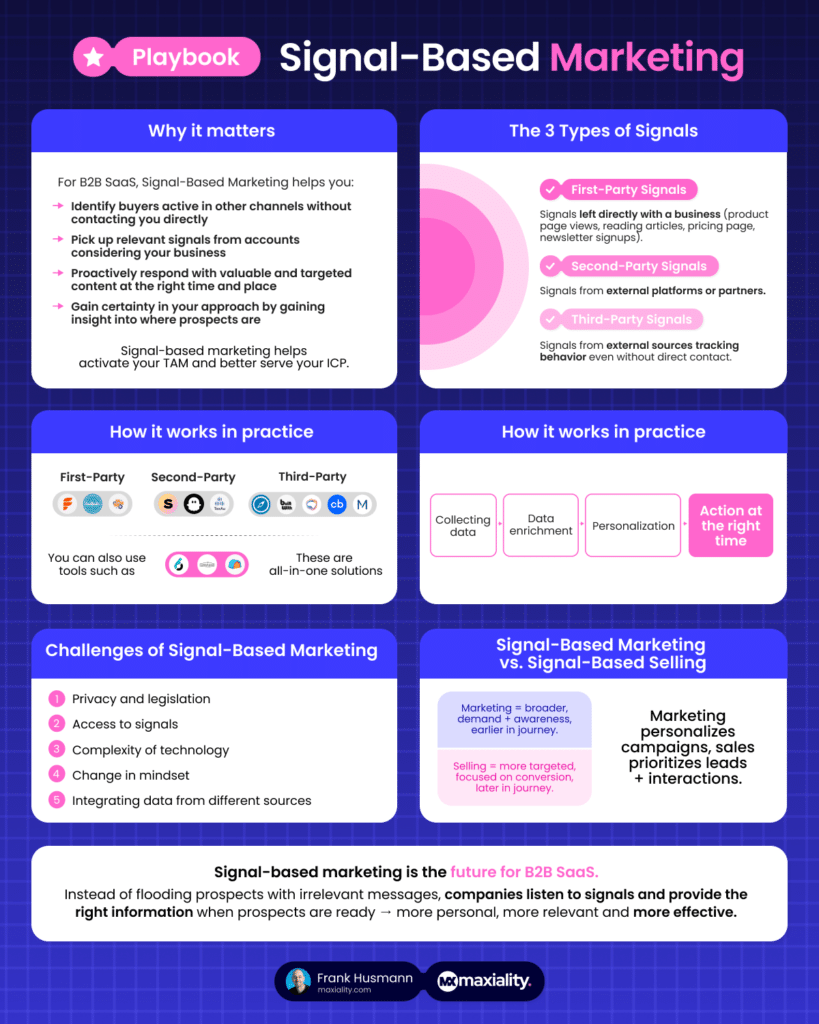
Signal-based marketing is an approach in which companies respond to specific signals that prospects give through their online behavior, interactions and other relevant actions. Examples include visiting certain pages (a pricing page, for example), asking certain questions on LinkedIn or communities, or leaving a review.
By understanding this behavior, you can more accurately match your marketing efforts to the real needs and intentions of your target audience. The result? More personalized, timely and relevant communications that increase the likelihood that prospects will actually convert to customers.
Why signal-based marketing keeps getting more important
B2B buyers do more and more of their research out of sight. They dig into communities, read reviews, ask questions on LinkedIn, and discuss tools in private channels. This is called “dark social”.
The result? You no longer see when a prospect gets interested in your product. And that’s more expensive than you think.
The decision is made before you’re even in the picture
6sense has studied this for years among thousands of real B2B buyers. Their findings from the Buyer Experience Report are uncomfortable (source):
- Buyers are about 70% through their journey before they even talk to a vendor.
- By the time of that first contact, 81% already have a preferred vendor.
- And 85% have already locked in their requirements. At best, you get to fill in what someone else already decided.
Read those three numbers again. If you wait for someone to fill out a form, you show up right when the shortlist is done and the winner already picked. You’re not a candidate anymore. You’re a second quote.
But that percentage is shifting
In the 2025 report, 6sense sees the ratio tilt from 70/30 to 60/40. The point of first contact moved from 69% to 61% of the journey. Buyers are actually reaching out earlier than before.
The reason? AI. Nearly nine out of ten purchases now involve AI functionality, and buyers can’t get those claims validated through websites or LLMs. For that, they need to talk to a human. So they call sooner.
Don’t mistake this for good news. Even in that shorter journey, 94% of buying groups have already ranked a preferred vendor before first contact, and that preferred vendor wins about 80% of the time. The window to influence the outcome hasn’t gotten bigger. It’s gotten smaller.
Your website tells you almost nothing
The average B2B website converts 2 to 4% of its visitors. That means over 96% leave without a trace. No name, no company, no signal.
Those people often did have intent. They just weren’t ready to identify themselves, and your only offer was a form.
It’s not a buyer, it’s a buying committee
Another reason lead-based thinking no longer works. That same 6sense research puts the average buying group at 10.1 people. Forrester’s State of Business Buying research lands on 13 stakeholders in a typical buying group for a complex solution. Each of those people shows up with four or five pieces of self-gathered research, which they then share and argue over with each other.
For comparison: Gartner’s Digital B2B Buyer Survey found 6 to 10 decision-makers, but that research dates back to 2017 and has been quoted everywhere since as if it were fresh. The direction is clear either way: the table keeps getting more crowded.
What does that mean in practice? One filled-out form from one person tells you almost nothing about what’s happening inside that account. Six people researching independently can produce six separate “leads,” or zero, since most of the time they don’t fill anything in at all.
That’s why signal-based marketing measures at the account level, not the lead level. What matters more than who downloaded something is how many different people from that company visited your site in the past two weeks, and which pages they looked at.
That second number tells you something. The first one is noise.
And AI is pushing the research even further out of sight
From that same 6sense research: 94% of B2B buyers now use LLMs during their buying process. They summarize reviews, run comparisons, build shortlists.
That’s one of the fastest adoption curves ever measured in enterprise software. Part of your buying process now happens inside a chat window you have zero visibility into, and the only way in is being visible in the sources those models pull from. I wrote about this earlier in my guide on GEO and AI Search.
Signal-based marketing makes these hidden buying moments visible. You analyze signals like website visits, product usage, hiring activity, and content engagement. That lets you act at the right moment in the buying process, meaning before the preference is already locked in.
Benefits of Signal-Based Marketing
For B2B SaaS companies, signal-based marketing is more important now than ever. It gives you the tools to communicate with your ideal prospects in a targeted, effective way. The benefits are that it helps you:
- Recognize buying intent from prospects who are active on other channels, like LinkedIn, communities, or review sites, without ever making direct contact with you.
- Detect relevant signals from accounts researching your product, so you know who’s showing interest even when they’re not explicitly asking about your services.
- Act at the right moment by offering valuable, targeted content at the right time and in the right place, for example during a product trial or in an online discussion.
- Gain confidence in your approach by getting visibility into where your prospects actually are, so you can reach them in the right places, at the right time, instead of hoping they show up somewhere.
But the biggest benefit is one that rarely gets mentioned: you stop wasting money on accounts that were never going to buy.
For this, Ebsta and Pavilion didn’t analyze surveys but real pipeline data: 655,000 opportunities, worth $48 billion combined. Their finding: when the decision-maker gets involved early in the process, the win rate is 55% higher. From the same dataset: deals that close within fifty days win about 47% of the time, deals that run longer than that win only around 20%.
That’s the whole point in one number. Signal-based marketing doesn’t change what you say, it changes when you say it. And timing turns out not to be a soft factor, but one of the few levers you can actually measure and pull.
And that’s exactly what it comes down to for a B2B SaaS with a well-defined TAM. You don’t have a hundred thousand potential customers. You might have 1,200. The question isn’t how to reach more of them, it’s which of those twelve hundred are in motion right now.
Signal-Based Marketing helps you recognize the right signals and understand where opportunities lie within your Total Addressable Market (TAM). This allows you to better serve your Ideal Customer Profile (ICP – ideal customer profile) and activate the market.
The 3 Types of Signals For Signal-Based Marketing
You leave signals every day without realizing it. Think about clicking on a link, watching a video, or signing up for a newsletter. Signal-based marketing extracts value from these small, often inconspicuous actions and divides them into three categories:
- First-Party Signals (proprietary data) These are the signals you leave directly with a business. Imagine visiting a website and viewing a product page, reading an article, or signing up for a newsletter. These are concrete first signals of interest. For example, if you view the pricing page on a SaaS’s website, this may indicate that you are considering purchasing their solution. The company may use these signals to later offer you a demo or direct you to a case that will help you further in your decision.
You can extract first-party intent signals, for example, from your own CRM, tools like LeadFeeder or Factors.ai that can recognize companies or e-mail automation software (webinar signups). - Second-Party Signals Second-party signals come from external platforms or partners the company works with. While many go-to-market frameworks loosely label LinkedIn engagement and intent platforms as “second-party signals,” these sources are technically third-party. True second-party intent signals require a direct, contractual data-sharing relationship between two organizations.
A common example is partner account and customer overlap shared through ecosystem platforms like Crossbeam, Reveal, or WorkSpan. For instance, an integration partner may share a list of customers actively using their product or expanding usage, indicating potential demand for complementary software. Another example is co-marketing or co-selling partnerships where a partner shares webinar registrants, content download activity, or product adoption signals directly with you. Because these insights originate from a partner’s owned first-party data and are exchanged through a bilateral agreement, they qualify as true second-party intent signals. - Third-Party Signals Third-party signals come from external sources that track the behavior of prospects and companies, even if they have not yet had direct contact with your company. Some key examples include:
- LinkedIn activity: Say you recently shared a post in a LinkedIn group about cloud solutions or liked a post about a new technology in a specialized community. This behavior shows where your interest lies, even if you haven’t connected directly with the company. For example, a company that sells software for digital marketing may notice that you are active in a group about marketing automation on LinkedIn. This may prompt them to send you a specific offer or invite you to a webinar about their product.
Socials listening tools such as Buska.io and Octolens or scraping tools like Phantombuster or TexAU can help you do this. - Job postings or promotions: When companies open new positions on job boards, this can signal growth or change within the company. For example, if a company appoints a new marketing manager or IT director, this may signal that they are looking for new solutions that fit their strategy or business growth. A promotion can also be a signal to take action on. Tools such as LinkedIn Sales Navigator, Mantiks or TheirStack can help you with this.
- Technographics: This refers to signals that show what technologies and tools a company uses or has acquired. For example, if a prospect starts using Hubspot or Salesforce, this may indicate that they need additional tools that integrate with their existing systems. This can be an opportunity to offer a solution that fits well with their current tech stack. Tools like BuiltWith and Wappalyzer can help you with this.
- Review sites: Suppose a prospect is researching CRM software and spends the entire morning comparing different vendors on G2. Because these vendors have a direct data partnership with G2, they receive a real-time notification: “An anonymous visitor from [Company Name] is currently researching your category.” Even though the prospect hasn’t visited the vendor’s website yet, they can already reach out with a perfectly timed demo offer.
- News & Events: Companies making important announcements, such as launching a new product, an acquisition or raising investments, may indicate that they are looking for new solutions to support their business goals. For example, if a company has just closed a significant funding round, it may indicate that they are looking to scale up quickly, providing an opportunity for targeted marketing and sales efforts. A news and social media monitoring tools like Talkwalker, Buska.io, Octolens and Snitchfeed can help you do this. And with Crunchbase or Signalbase, you can find out if investments have been raised.
- LinkedIn activity: Say you recently shared a post in a LinkedIn group about cloud solutions or liked a post about a new technology in a specialized community. This behavior shows where your interest lies, even if you haven’t connected directly with the company. For example, a company that sells software for digital marketing may notice that you are active in a group about marketing automation on LinkedIn. This may prompt them to send you a specific offer or invite you to a webinar about their product.
By cleverly combining all these signals, companies can get a better picture of your needs and interests, even without access to the “invisible” places (dark social) where you are active. The point is not to know everything about you, but to understand enough signals to target you in a relevant way.
How Signal-Based Marketing Works in Practice
You may be wondering: how do companies turn all those signals into action? The process starts with smart data collection and ends with personalized marketing delivered at exactly the right time. Here’s how it works:
- Collecting data Companies collect signals from a variety of sources. This can be as simple as tracking which pages you visit on their website, but also more complex data from platforms or tools such as CRM systems and intent platforms. The goal is to capture a wide range of signals without violating your privacy.
- Data enrichment Data enrichment is an essential step when deploying intent data in intent-based marketing. By enriching existing customer and prospect data with additional information, such as company size, industry, technographic data and behavioral patterns, you get a more complete picture of your target audience. This allows you to better interpret and prioritize intent signals, such as search behavior or content interactions. Tools like Clay, Zapier combined with ChatGPT, LinkedIn Sales Navigator or BuiltWith can help you do this.
- Personalization This is where it gets interesting. Based on the data analyzed, companies can target you with content, offers or information that matches what you are looking for. Think of an invitation to a webinar exactly about that one topic you showed interest in earlier, or an email with tips specifically tailored to your situation.
- Action at the right time It’s all about timing. Signal-based marketing ensures that companies approach you at the time you are most receptive. For example, if you’ve viewed a product page, a company can send a valuable proposal shortly after, without feeling intrusive.
Signal-based marketing is not just collecting and deploying data – it’s about smartly understanding what that data means and how to act on it. The result? Marketing that feels like a valuable addition rather than a disruptive interruption.
Example of Signal-Based Marketing
For all SaaS clients, I deliver a summary of the following data once or twice a month:
- companies that have had LinkedIn Ads interactions using LinkedIn Campaignmanager
- companies visiting key pages on the site via tools to recognize companies
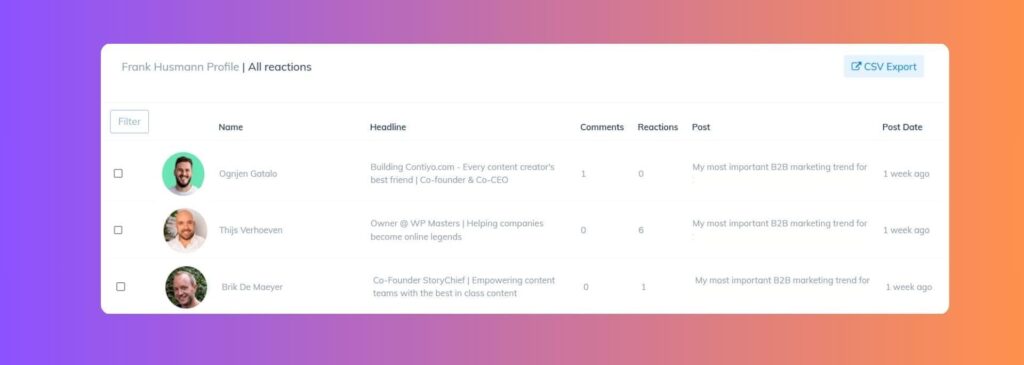
- responses to LinkedIn ads and organic posts via our proprietary tool, this can also be done with Phantombuster or TextAU if needed
This data is a valuable source of sales. They engage with this by adding individuals to their own LinkedIn network. Or they send an e-mail or call, depending on the level of intent and the sales playbook.
Another example is a SaaS customer in the HR tech sector. They integrate with specific Applicant Tracking Systems (ATS) that let their customers, Randstad for example, automate their entire recruitment and selection process.
For this client, I built software that detects which ATS these companies use, and uses that to enrich the intent data. That lets me filter out the noise, so sales can start working the right leads.
Tools For Signal-Based Marketing
Below is an overview of tools that can help you collect intent signals:
| Category | Tool | Description |
| First-Party Signals | CRM | Used to extract data directly from your own customer management, such as customer interaction and leads. |
| LeadFeeder, Factors.ai | Recognizes companies visiting your website. | |
| E-mail Automation Software | Collects data from such things as webinar registrations and newsletter activity. | |
| Second-Party Signals | Crossbeam, Reveal, or WorkSpan | Partner account and customer overlap shared through ecosystem platforms |
| Third-Party Signals | LinkedIn Sales Navigator | Used for insight into job openings, promotions and new positions with prospects. |
| LinkedIn Campaign Manager | If you use LinkedIn Ads, you can see which companies have interactions with your ads. | |
| Mantiks, TheirStack | Collect signals such as growth or change of roles within companies. | |
| BuiltWith, Wappalyzer | Technographic insights about what tools a company uses. | |
| Buska.io, Octolens, Talkwalker | Monitor news and social media for business-related signals. Helps to collect and analyze data from external platforms. | |
| Crunchbase, Signalbase, Forager.ai | Provides insight into investments, acquisitions and business growth. | |
| G2 | Platform where organisations look for technologies, providing insight into buying intentions. | |
| Phantombuster, TexAU | For scraping interaction data from platforms such as LinkedIn, reviews from G2 and other platforms. |
You can also use tools such as Clay, Common Room or 6Sense. These are all-in-one solutions and the monthly subscription starts at around $349 per month.
How To Get Started With Signal-Based Marketing
Start by identifying which signals are relevant to make decisions on. Once you’ve identified those, check with sales to see what the most valuable signals are.
The next step is to collect and possibly enrich the data through the tools I discussed above. Our advice is to do this manually first before automating with Zapier, Make or Clay. Put the intent signals into a (Google) sheet and share them with sales. You can also choose to use this data to set up your own personalized campaigns.
The frequency of making these lists depends on the amount of data. Our B2B SaaS clients do not have a large TAM (Total Addressable Market) so 1 or 2x per month is sufficient. With a lot of data you would want to collect this more often or even in real time and forward it to sales.
Challenges of Signal-Based Marketing
While signal-based marketing offers many advantages, it also comes with a number of challenges. It is not a matter of simply collecting and using data – it requires diligence, technology and a strategic approach. Here are the main obstacles companies face:
- Privacy and legislation Privacy laws, such as the AVG (GDPR), are becoming more stringent. Buyers expect companies to use their data carefully and ethically. This means companies need to think carefully about how they collect and deploy signals without infringing on customer privacy. Balancing personalization and transparency is a challenge that cannot be ignored.
- Access to signals With the rise of dark social and closed platforms, companies have less direct access to the entire customer journey. This makes it harder to catch signals. They therefore need to focus on the signals that are indeed available, such as interactions on their own website or platform, and get creative with external data.
- Complexity of technology Collecting, analyzing and interpreting signals requires advanced technologies such as machine learning and data analysis tools. Not every company has the knowledge or resources to implement these systems effectively. This can lead to challenges in translating raw data into actionable insights.
- Change in mindset Signal-based marketing requires a fundamental change in how companies think about marketing. It is no longer about sending, but about listening and anticipating. For many organizations, this is a major shift that requires training, time and dedication.
- Integrating data from different sources To get a complete picture of the customer, companies need to combine data from different sources – from website behavior and CRM systems to intent data from external platforms. This requires strong data integration and a holistic view of the customer journey.
Despite these challenges, signal-based marketing offers huge opportunities for companies willing to invest in the right tools and approach. The key to success lies in finding the balance between technology, privacy and a customer-centric mindset. For companies that get this right, a world of opportunity lies ahead.
What is The Difference Between Signal-Based Marketing And Signal-Based Selling?
Signal-based marketing and signal-based selling are both tactics that leverage “signals” — indicators of customer behavior, intent, or interest — to guide actions. The key difference lies in their application:
- Scope: Marketing is broader and focuses on creating demand and awareness, while selling is more targeted and aims to convert prospects into customers.
- Timing: Marketing often occurs earlier in the customer journey, whereas selling typically happens when a prospect shows clear buying intent.
- Execution: Marketing teams use signals to personalize campaigns and content, while sales teams use signals to prioritize leads and tailor their direct interactions with prospects.
Both approaches aim to increase relevance and effectiveness in customer interactions, but they operate at different stages of the customer journey and with different primary objectives.
What is the difference between intent data and signal-based marketing?
Intent data is the data itself (e.g., search behavior or content consumption). Signal-based marketing is the strategy by which companies use this data to automate or personalize actions.
How do you prevent data overload?
Focus on signals that correlate with closed deals. Not every website visit is relevant. Determine which combination of signals best predicts purchase intent.
Conclusion: Why Signal-based Marketing Is Becoming Increasingly Important For B2b Saas Companies
Signal-based marketing isn’t just a trend. That’s not an opinion, it’s clearly visible in the adoption numbers. According to 2025 research from DemandScience, 91% of B2B marketers now use intent data to prioritize accounts.
But here’s the number you rarely see in articles on this topic: only 24% get exceptional ROI out of it. 87% say their own marketing produces unreliable or inflated intent signals. And of all those signals, only 26% turn into a qualified opportunity. That’s from the same research.
So basically everyone, especially in the United States, is using signal-based marketing. Almost nobody is getting the full value out of it.
That’s not an argument against getting started. It’s an argument for starting it properly. Because the difference isn’t the tools, it’s the discipline behind them: do you know which signals preceded a deal for your specific customers, do you filter out the noise before sales sees it, and does something actually happen within a few days?
And you don’t need to start big. A company-recognition tool on your site, a LinkedIn Ads export of companies, a conversation with sales about what behavior preceded your last ten deals, and a Google Sheet you review once a month. That’s enough to start. The tooling and automation can come later.
Instead of flooding prospects with irrelevant messages, you listen to the signals they give off, and use them to offer exactly the information they need, at the moment they’re ready for it. It makes marketing more personal, more relevant, and far more effective, as part of your broader SaaS marketing.