


Most B2B deals that stall after a strong demo don’t go to a competitor. They die in the meeting after, when your champion has to sell you to colleagues you’ve never spoken to. In Dreamdata’s 2026 benchmark the average buying committee is ten people, and in most deals the founder has talked to one of them.
Most deals are lost to “do nothing”
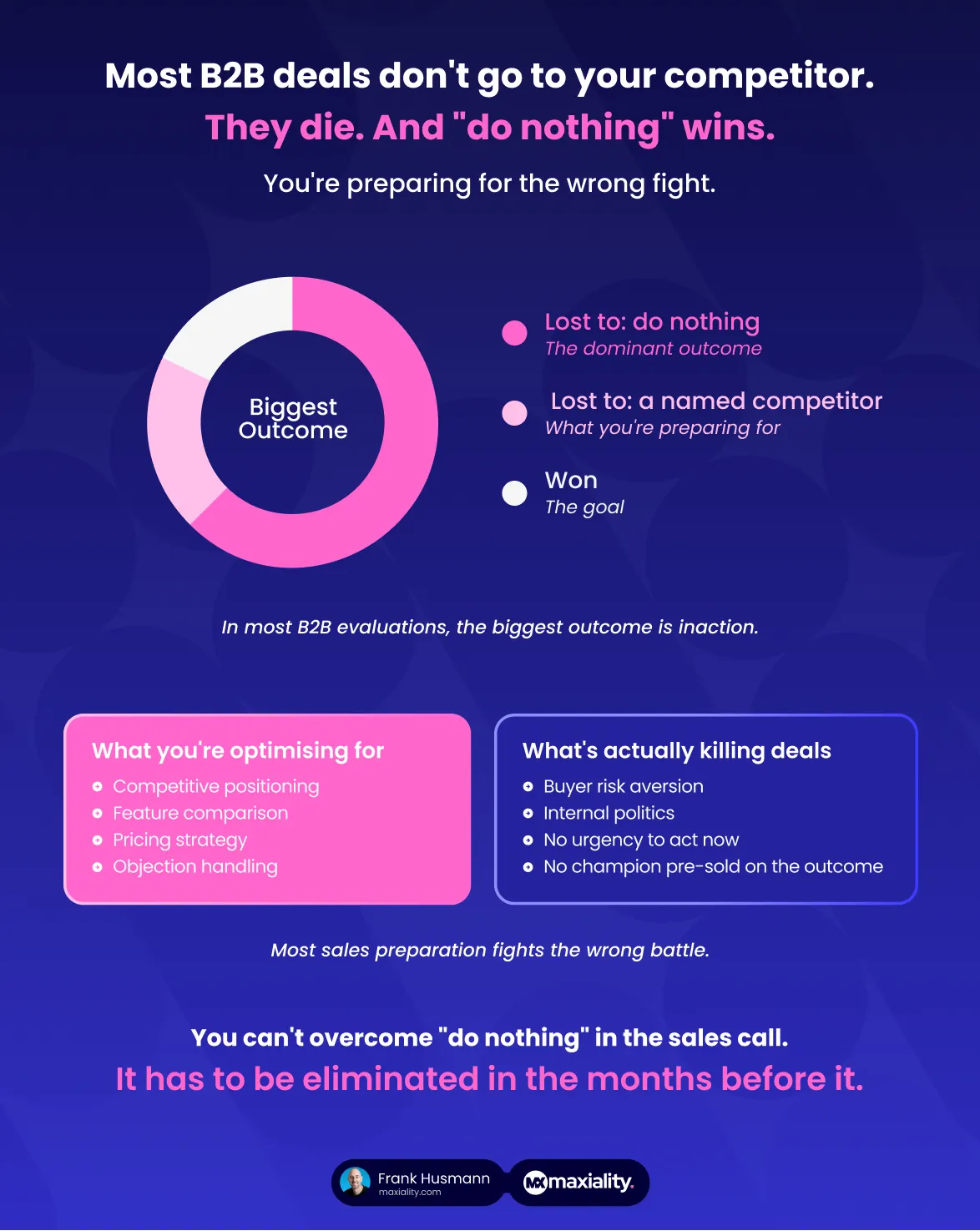
I’ve looked at pipeline data from over forty B2B SaaS companies. The biggest category of lost deals isn’t “lost to competitor”. It’s lost to inaction, and it rarely gets logged that way.
It shows up in polite language, like “Let’s revisit next quarter” or “We need to align internally first”. Those aren’t delays; they’re losses with better manners.
The buyer evaluates, hesitates and stays with the status quo, because deciding feels riskier than doing nothing. The current way of working is painful but familiar, and familiar pain beats unknown risk almost every time.
That makes most sales preparation a fight against the wrong opponent:
| What most teams optimise for | What actually kills the deal |
|---|---|
| Competitive positioning | Buyer risk aversion |
| Feature comparison | Internal politics |
| Pricing strategy | No urgency to act now |
| Objection handling | No champion who can carry it internally |
The left column is all about beating another vendor. None of it helps much when the real threat is a buyer who never decides.
What happens after your demo ends
From your side, the demo went well. From the buyer’s side, the real work is only starting, and you’re not in the room for any of it. The champion takes your story inside, and it goes through a budget review, a security check, a legal review and team alignment before anyone makes a decision.
Each of those steps comes with its own question, asked by someone who didn’t see your demo:
| Who asks | What they want to know |
|---|---|
| CEO | Is this the right priority now? |
| CFO | Where is the ROI? |
| Head of Sales | Will this disrupt my team? |
| IT | What are the integration risks? |
| Legal | What are the liability implications? |
Underneath those conversations sits a pile of work you never see: a budget justification, a security questionnaire, a switching-cost calculation, a plan for the team to change how they work, and contract negotiation. Your champion does all of it, mostly with whatever you left them after the call.
What founders blame, and what actually happened
A founder once sent me his pipeline report with three deals in “final stage”. All three were stalling. The champions were engaged and there were no hard objections, just silence.
He blamed the timing, a budget freeze and a buyer who went quiet after the demo. When we traced the deals back, the story was the same each time. The champion loved the product, but couldn’t answer the CFO’s ROI question in the internal review. There was no business case anyone could forward. IT raised a security concern, and nobody in the room could address it.
The deals didn’t die in the demo. They died in the meeting after, and the founder never found out why.
The champion test
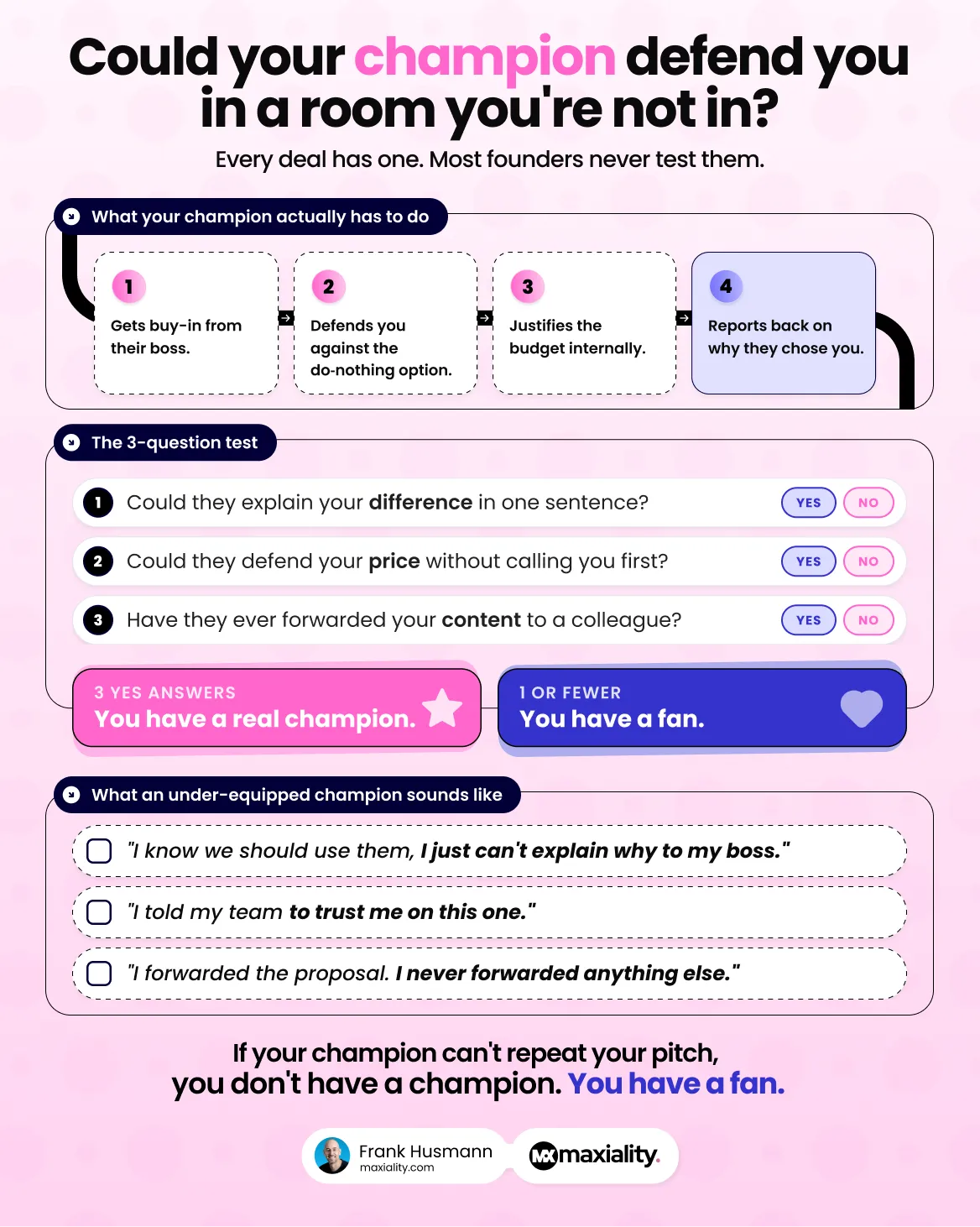
Every deal has a champion, and most founders never check whether that person can do the job. After your call ends, your champion has to:
- Get buy-in from their boss.
- Defend you against the do-nothing option.
- Justify the budget internally.
- Report back on why they chose you.
You can’t help with any of that directly. The version of your pitch that survives is the one they can repeat on their own. Three questions tell you whether they can:
- Could they explain your difference in one sentence?
- Could they defend your price without calling you first?
- Have they ever forwarded your content to a colleague?
Three yes answers means you have a real champion. One or fewer means you have a fan: someone who likes you and can’t sell you.
You can usually hear the difference. An under-equipped champion says things like “I know we should use them, I just can’t explain why to my boss”, or “I told my team to trust me on this one”. Run the test on your last stalled deal and see which question they would have failed.
How to equip your champion before the demo
You can’t win the meeting after the demo from inside the sales call. The answers your champion needs have to exist before it, in a form other people can find and forward. Founder-led content can carry four things:
- Market framing: why this problem matters now.
- Competitive clarity: why you, and not the alternative (including doing nothing).
- ROI logic: how to make the financial case to a CFO.
- Implementation confidence: how this works in practice, for IT and the people who’ll use it.
When that thinking has been visible in your niche for months, your champion walks into the internal review with answers instead of questions. The CFO may already have seen how you frame ROI, and IT may already know how you handle security.
It also matters how many people at the account know you before the deal starts. Factors.ai’s 2026 LinkedIn benchmark report found that accounts with six or more engaged contacts before the deal was created had a win rate 17.1 percentage points higher than accounts with a single engaged contact. That’s a correlation from a vendor report, not proof of cause. It does point the same way: the more of the committee has seen your thinking, the less your champion has to carry alone. Thought Leader Ads on LinkedIn are one way to put the founder’s posts in front of the rest of that committee.
Consistent founder point of view plus market presence gives you a champion who can sell without you. Getting there starts long before the deal, which is the same mechanism behind the shortlist threshold.
FAQ
Why do B2B deals stall after a good demo?
Usually because the decision moves into internal meetings you’re not part of. The champion has to answer the CFO, IT, legal and their own boss, and if they can’t explain your difference, your price or your ROI on their own, the safest option for everyone is to wait. That’s how a strong demo turns into “let’s revisit next quarter”.
What does “lost to do nothing” mean?
It means the buyer evaluated, didn’t pick anyone, and kept the status quo. In most CRMs those deals end up as “on hold” or “closed lost, no reason”, so the size of the problem stays hidden. In the pipelines I review, it’s the largest single reason deals are lost.
What’s the difference between a champion and a fan?
A fan likes your product and tells you so. A champion can explain your difference in one sentence, defend your price without calling you and gets your content in front of colleagues. If your contact needs you on the phone to answer every internal question, you have a fan.
How many people in the buying committee should know you?
As many as you can reach before the deal starts. The committee averages ten people, and Factors.ai’s data links six or more engaged contacts at an account to a clearly higher win rate. Practically, that means your content should reach finance, IT and the end users too, not only the person who books the demo.
Next step
Take your last two stalled deals and run the champion test on them. If you’d like a broader read on where your pipeline leaks, the GTM Signal Audit takes a few minutes. If you’d rather talk it through, book a call.