

In October 2024 we published our research into 3,000+ LinkedIn posts by SaaS founders. Five well-known founders posted 15 times a month, and 42% of their posts were thought leadership. The average founder posted twice a month, and more than half of that was reposts.
Two years is a long time on LinkedIn. The algorithm changed, and AI made writing a post almost free. So I went back to the same founders and measured them again, with the same categories as in 2024. Then we added new groups, and analyzed thousands of LinkedIn posts in total.
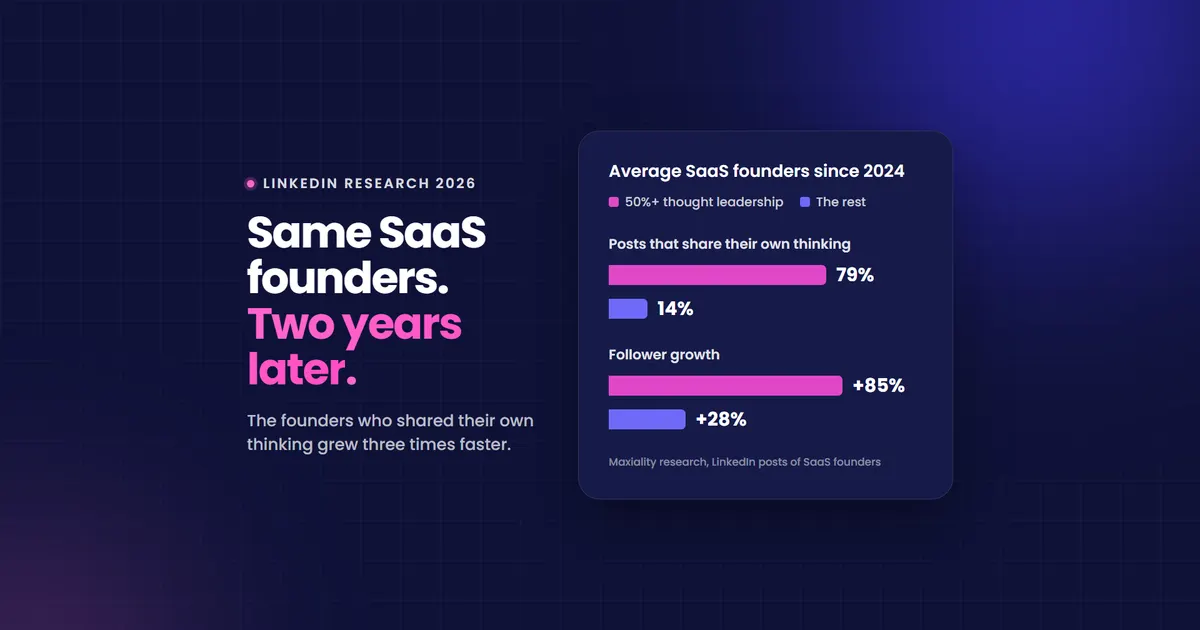
Two things surprised me. The top five barely changed, apart from posting half as much video. And in the average group, the few founders who mostly shared their own thinking grew their audience three times faster than the rest, without posting much more often.
Why this matters for SaaS founders
Your buyers decide long before they talk to you. Dreamdata’s 2026 benchmark, which tracks real deal journeys, shows that 81% of the research phase happens before sales gets involved. Often, what they find is your LinkedIn feed.
How often SaaS founders post on LinkedIn: the numbers
The short answer: the best-known SaaS founders post about 15 times a month, the average founder once or twice. But frequency isn’t what set the fastest growers apart. The average founders who grew their audience fastest posted 2.3 times a month, and 79% of their posts shared their own thinking.
Source: Maxiality research into SaaS founders on LinkedIn, 2026.
Look at the middle of those numbers. The fastest growers in the average group post a bit more than the rest, and less than the founders of Deloitte Fast 50 companies. Yet they grew their audience three times faster. The difference is what they post, and that’s what most of this article is about.
At the top, volume does count. The top founder who posted most also grew fastest, and the one who cut back was the only one who lost followers. Posting a lot doesn’t wear people out either: one founder in this research posts more than twice a day and gets the same response per follower as the top five.
Careful with that 2.3, though. It’s a small group, and most of them started from a small audience: growing 85% is easier from 2,000 followers than from 80,000. What the data shows is that substance made the difference at the same low volume. It doesn’t prove 2.3 posts a month is enough.
So my advice is a minimum of one post a week that shares your own thinking. With two posts a month you get 24 posts a year, too few to see which topics and formats land with your buyers. Weekly, you can adjust after a quarter. Add volume once you have a system that keeps feeding you material, because months of consistency count for more than one busy week.
How we ran the 2026 update
Across all groups we collected and analyzed thousands of LinkedIn posts. For the top five, we pulled every post they published in the six months before this update: 468 posts. For the average founders we took their last 20 posts, the same approach as in 2024.
Every original post got one category, using the same list as in 2024: thought leadership, company and product, events, personal, team, partnerships, funding, or other. Reposts were counted separately and left out of the content split, as before.
The bar for thought leadership is strict. A post only counts when the reader learns something from the post itself: an opinion, a lesson, a framework, a data insight about the founder’s field. A post that announces a webinar, a report or a newsletter where the insight lives counts as events or company and product, even when the topic is smart. We checked a random sample of 30 labels by hand, and 29 matched.
We also added new groups. Founders who are often named as strong examples of founder-led content: Amanda Zhu (Recall.ai), Melissa Rosenthal (Outlever), Nate Nasralla (Fluint) and Nathan Barry (Kit). Founders of much bigger companies, Dharmesh Shah (HubSpot) and Varun Anand (Clay), as a reference point. Founders who speak at B2B SaaS events. And the B2B SaaS founders in the Deloitte Technology Fast 50 for 2026, to see whether the fastest-growing companies also have the most visible founders.
The top five: same rhythm, same focus, half the video
The five are the same founders as in 2024: Guillaume Moubeche of lemlist, Adam Robinson of RB2B, who sadly passed away shortly before we published this update, Peep Laja of Wynter, Alina Vandenberghe of Chili Piper and Rand Fishkin of SparkToro.
Two years, a new algorithm and a flood of AI content, and the habits of the best founders on LinkedIn look almost the same. They still post about every other day, 15.6 times a month against 15 in 2024. Roughly half of what they write is their own thinking: 41% measured exactly the 2024 way, 47% over the full six months. The audience kept growing anyway, with average followers up 45%, from 78,212 to 113,637.
Share of posts. Thought leadership measured the 2024 way for both years. Source: Maxiality research into SaaS founders on LinkedIn, 2024 and 2026.
Underneath the averages the five are quite different. Peep Laja is the purest example: 72% of his posts are thought leadership on positioning and buyer research. Rand Fishkin is the only one who still posts a lot of video (36%), and he has the biggest audience at 216,224 followers. Alina Vandenberghe posts the most, almost 22 times a month, but only 26% of that is thought leadership, and most of her reposts are plain shares of other people’s posts.
The top five also promote their companies. Across the five, 18% of their own posts are about the company or product, and 13% about events. That share never becomes the main part of the feed, and that’s the difference with most founders: promotion is the exception that the thinking pays for.
Adam was a great inspiration for many SaaS founders, because he shared his journey so openly, including what didn’t work. We measured him in 2024, so he stays in. Over these six months he posted close to 19 times a month, and 43% of it was thought leadership. For anyone who followed him, that won’t be a surprise.
At the top, stopping costs you your audience
The follower counts per founder tell a story the averages hide. The 2024 numbers are the ones we published in the original article.
Posts per month over May to November 2026. Source: Maxiality research into SaaS founders on LinkedIn, 2024 and 2026.
Guillaume Moubeche has moved on. He now spends most of his time investing, and his posting dropped to 4.5 posts a month. When he does post, 59% of it is still thought leadership. He’s also the only one of the five who lost followers.
Alina is the mirror image. She posts the most of the five, and her audience more than doubled. Her thought leadership share is the lowest of the group, so this isn’t a case for volume over substance. It shows that at this level, showing up week after week keeps compounding. And that an audience you stop feeding slowly walks away, even one of 55,000 people.
The average founder: still barely posting
We went back to the B2B SaaS founders we could trace from our 2024 average group and pulled their last 20 posts. Some no longer run that company, and others posted at most once in the last six months, so we left them out.
The founders who are still active post even less than the average founder did two years ago:
| 2024 | 2026 (active founders) | |
|---|---|---|
| Posts per month | 2 | 1.4 |
| Thought leadership | 8.1% | 33.5% |
| Reposts | 51% | 42% |
| Video | 14% | 5% |
The jump in thought leadership looks like good news, and part of it is. But a big share comes from leaving out the founders who stopped. And from a small group of founders who changed how they use LinkedIn. Take them out, and the rest sit at 14% thought leadership. More than half of those didn’t post a single piece of their own thinking in their last 20 posts.
The founders who shared their own thinking grew three times faster
That small group is the most interesting part of the update.
Active founders from our 2024 average group, last 20 posts each. Source: Maxiality research into SaaS founders on LinkedIn, 2024 and 2026.
They post a little more often than the rest, but nowhere near the top five. What changed is what they post. Nicola Ebmeyer, co-founder of Gain.pro, posts data breakdowns of private equity built on her company’s own research. She went from 2,320 followers in 2024 to 15,596 now. Shanna Baakman of Arbor Media writes essays on trust and where information comes from, and her audience grew from 845 to 3,379.
It’s a small group, so treat this as a strong signal rather than a law. But the direction matches everything else in this research. Posting more of the same doesn’t build an audience. A clear opinion, repeated in different ways over months, does: it’s the Opinion Density idea I write about a lot, and this group is the clearest example of it in our own data.
4 forms of LinkedIn thought leadership that worked for SaaS founders
Thought leadership sounds like long essays. In our data it’s mostly not. The founders with the highest share each found a format they can keep up, and the formats are very different.
Your own data. Peep Laja (72% thought leadership) builds many of his posts on Wynter’s own buyer research. Nicola Ebmeyer does the same with Gain.pro’s private equity data. If your product sits on data nobody else has, that’s the easiest material you’ll ever get.
Your take on the news. Melissa Rosenthal posts about 68 times a month, and 92% of it is thought leadership. Almost every post takes a fresh AI or marketing story and adds her own angle for B2B buyers and marketers, with a link to her company’s own publications. The news supplies the topic. She supplies the opinion.
Lessons with hard numbers. Amanda Zhu, co-founder of Recall.ai, grew to more than 56,000 followers with concrete sales lessons: what worked in cold outbound, why a deal was lost, what a discovery call should cover. Each one comes with a number from her own deals. She posted no videos and no reposts in six months. Her co-founder and CEO, David Gu, only reposted, six times in six months. The voice of a company doesn’t have to be the CEO.
Things the reader can copy. Nate Nasralla’s feed is 82% thought leadership, and much of it is templates: the exact email to send a stalled deal, the sentence to open an exec summary with. Readers save posts like that, and they come back for the next one.
All of them post more thought leadership than the top five, and none of them leans on reposts.
Fewer founders post video. That’s your opening.
Video dropped across the board. The top five halved their share, from 24% to 12%, and the average founders went from 14% to 5%. One likely reason for regular founders: AI made a written post a matter of minutes, while a video still needs you in front of a camera.
Source: Maxiality research into SaaS founders on LinkedIn, 2024 and 2026.
That’s exactly why I’d keep video in the mix. In a feed that fills up with AI-written text, a founder on camera is the one thing nobody can fake. Buyers hear how you think and how you explain your field, and whether you know what you’re talking about. With fewer founders doing it, a good clip stands out more now than it did two years ago.
Rand Fishkin shows what that looks like. He’s the top founder who kept video at the center of his feed: 36% of his posts, most of them short clips where he makes one point about marketing or search in his own words. He also has the biggest audience of the five, at 216,224 followers, and grew 36% in two years.
The data does show that the type of video matters. Nathan Barry, founder of Kit, posts more video than anyone in this research: 65% of his posts, mostly clips from his own podcast. Many of those clips announce a new episode or quote a guest. His videos average 51 reactions and comments, his other posts 108.
What works is you, making one point of your own. When we turned a founder interview into short video posts for StoryChief, their CRO had two demo requests within the first ten days. Each clip was the founder, in his own words, on one topic his buyers cared about.
A big audience doesn’t buy attention
Follower counts are the number everyone looks at, and they matter less every year. LinkedIn now decides who sees a post mostly on interest in the topic, not on who follows you, so a large part of your reach goes to people outside your network. A big following doesn’t guarantee that your posts get seen, let alone read.
So we looked at response instead: reactions and comments per post for every 1,000 followers. It’s a rough yardstick, because the people reacting aren’t all followers. But it shows how much a post moves people relative to the audience a founder has built.
Average over May to November 2026. Source: Maxiality research into SaaS founders on LinkedIn, 2026.
Dharmesh has the biggest audience in this research by far, and the lowest response per follower. That mostly shows that reach no longer grows with your follower count: LinkedIn doesn’t show his posts to 1.2 million people, it shows them to the people interested in the topic. He also shows a pattern that stands out: almost a third of his posts are reposts, and a third of his own posts promote products, mostly his side projects.
Volume doesn’t wear an audience out either. Melissa posts more than twice a day and still gets the same response per follower as the top five. Guillaume posts least and scores highest.
One exception keeps us honest. Varun Anand, co-founder of Clay, posts mostly product launches, events and team news, with a lot of video. Only 15% is thought leadership, and he still gets 15 reactions and comments per 1,000 followers, the highest of anyone we measured this way. When your company is the news your market follows, company news works. For most founders it isn’t, yet.
Fast growth doesn’t make a founder visible
You’d expect the founders of the fastest-growing companies to be the most visible. They aren’t, even though the fastest-growing SaaS companies lean on founder-led marketing more than ever.
We took the B2B SaaS companies in our size range from the Deloitte Technology Fast 50 for 2026 and looked up their founders. A few posted at most once in six months. The rest post 2.6 times a month on average, and 53% of their posts are reposts: the highest share of any group we measured. Only one of them mostly shares their own thinking.
It’s a small sample. Still, it fits what I see in sales calls every month. Most of these companies grow through sales, partners or a strong product, and the founder’s expertise stays in their head and in their calls. That works for a while. It also means that every buyer who researches them on their own, months before they talk to sales and often through channels you can’t track, meets a repost of an event, a webinar or company news, and rarely anything the founder thinks.
The founders who speak on stages look different. We measured founders who speak at B2B SaaS events: 44% of their own posts are thought leadership, against 34% for the active average founders, and only 27% of their posts are reposts. They post about as rarely, 1.8 times a month. But when they post, it’s more often something they think. That makes sense: if you’re asked to speak, you already have a point of view worth sharing. Most founders have one too. They just never write it down.
Source: Maxiality research into SaaS founders on LinkedIn, 2026.
What I’d do with this as a SaaS founder
I keep coming back to two numbers: 79% versus 14%. The founders who grew didn’t post three times more, they posted their own thinking instead of other people’s.
If you run a B2B SaaS company and LinkedIn feels like a chore, start small:
- Count your last 20 posts. How many teach the reader something they can use? If it’s under five, that’s your first fix, before posting more often.
- Drop the plain reposts. Founders who share mostly other people’s posts grew the slowest in our data. Those reposts are often company news, events and webinars: they tell your market what’s on the calendar, not what you think. If you share something, add your own take.
- Pick a format you can keep up. Your own data, your take on the news, lessons with numbers, or templates people can copy. One format you can run every week beats four you try once.
- Pick two or three points of view and repeat them. Start from the questions your buyers ask in sales calls, and the things you disagree with in your market. Nicola posts about private equity data, week after week. Nobody gets bored; they start to associate the topic with her.
- Get it out of your head once a month. Block 45 minutes, have someone interview you with those buyer questions, and record it on video. One conversation fills a month. Posts, clips and an article all come out of it: that’s content repurposing, and it keeps a format going without a blank page every week.
- Get on camera. A short clip of you making one point is the part of your feed AI can’t write for you, and fewer founders bother now. Skip the episode promos; one opinion per video, in your own words, like Rand Fishkin does.
- Pay to get your best thinking in front of your ICP. Organic reach is a lottery. Every month, pick the posts that did best and put them behind Thought Leader Ads, so the founder’s best thinking reaches the accounts on your ICP list. Across our clients, 52% to 57% of open deals had seen our LinkedIn Ads, measured in the CRM. See our guide to LinkedIn Thought Leader Ads.
You don’t need to post every other day like the top five. Once a week is enough to start, if you have something to say and the discipline to keep saying it for months.
FAQ
How often should a B2B SaaS founder post on LinkedIn?
The top five founders in our research post about 15 times a month. Most founders don’t need that. The average founders who grew fastest posted 2.3 times a month, and 79% of those posts shared their own thinking. We advise at least one post a week, because with fewer you can’t see what works with your buyers. Add volume once a system keeps feeding you material.
Does video still work on LinkedIn for founders?
Yes, when the video is you making a point of your own. Fewer founders post video than two years ago: the share dropped from 24% to 12% for the top five, and from 14% to 5% for the average group. That makes a good clip stand out more, and in a feed full of AI-written text it’s the clearest proof that a real expert is talking. Episode promos and guest quotes do less: the founder who posts the most video got half the response on those videos compared to his other posts.
What counts as thought leadership on LinkedIn?
A post counts when the reader learns something from the post itself: an opinion, a lesson, a framework or a data insight about your field. Announcing a webinar, report or newsletter where the insight lives doesn’t count, even when the topic is smart. In our research, the founders who grew fastest shared their own thinking in 79% of their posts. The rest stayed at 14%.
Does follower count still matter on LinkedIn?
Less than it used to. LinkedIn now decides who sees a post mostly on interest in the topic, so a large part of your reach comes from outside your network. The founder with the biggest audience in our research, 1.2 million followers, got the lowest response per follower. Whether your posts teach your buyers something matters more.
Conclusion
The founders who were winning on LinkedIn in 2024 are still winning, with almost the same habits. The average founder still barely posts: 1.4 times a month, and four in ten of those posts are reposts. Between those two groups sits a small set of founders who prove you don’t need a huge audience to grow one. They share what they know and keep repeating it.
Most founders I talk to have the expertise. What they don’t have is a system that gets it out of their head every month without costing them a day a week. That’s the engine we build: one interview a month, turned into posts, articles and clips in your voice, and put in front of your ICP.