


Most B2B buyers already have two or three companies in mind before they start searching. The evaluation they run after that mostly confirms the list they walked in with. I call the line between being on that list and not being on it the shortlist threshold, and most B2B SaaS founders I talk to have never checked which side of it they’re on.
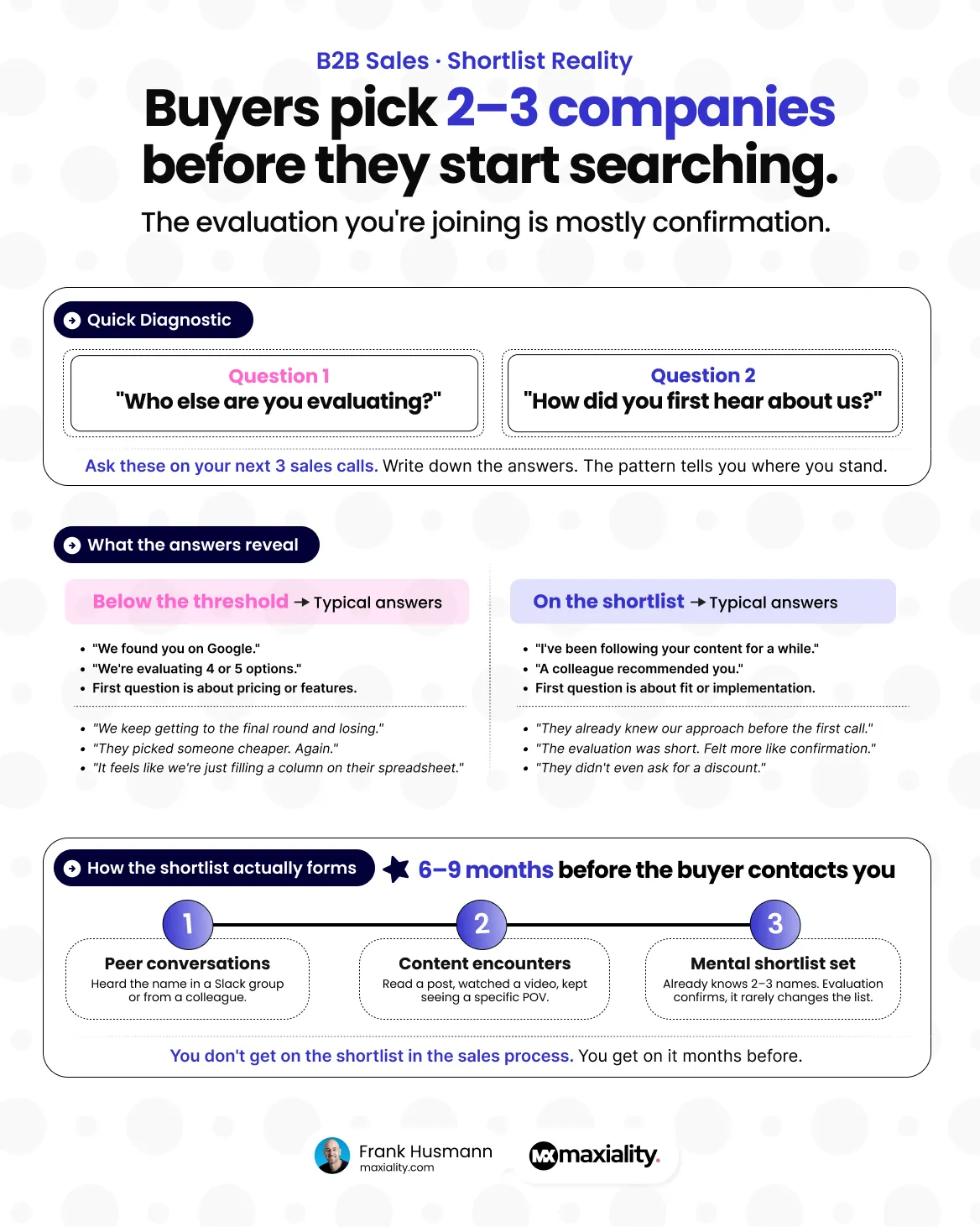
Two questions that show where you stand
You don’t need a dashboard for this. Ask these two questions on your next three sales calls:
- “Who else are you evaluating?”
- “How did you first hear about us?”
Write down the answers word for word. I ask both in every pipeline review I do with founders, because after a handful of calls the pattern says more about your go-to-market than most CRM reports will.
What the answers reveal
The answers tend to fall into two groups, and they rarely mix.
Below the threshold, buyers say they found you on Google and are looking at four or five options. Their first question is about pricing or features. You arrived after the shortlist had formed, so there’s no earlier trust to build on and you get compared as a commodity before you’ve said much. Founders in this position tell me the same things: they keep reaching the final round and losing, often to someone cheaper.
On the shortlist, the answers sound different. “A colleague recommended you.” “I’ve been following your content for a while.” The first question is about fit: how does this work with our current setup? The evaluation is short, and nobody asks for a discount because the buyer already decided you were worth the money.
| Below the threshold | On the shortlist | |
|---|---|---|
| How they found you | Search, a comparison site | A colleague, your content |
| Other vendors in play | Four or five | One or two |
| First question | Price and features | Fit and implementation |
| The evaluation | A long comparison | A short confirmation |
Same niche, completely different starting point.
Why the evaluation rarely changes the list
It’s tempting to think a strong demo can pull you onto the list late. The data says that window is mostly closed by the time a buyer gets in touch. In 6sense’s 2024 Buyer Experience Report, buyers were about 70% through their journey before they spoke to a vendor, and 81% already had a preferred vendor at that first contact.
That’s why the evaluation feels like confirmation from the buyer’s side. They’re checking whether the names they already trust hold up, and adding one or two others so the comparison looks fair internally. If you’re one of those extra names, you’re the second quote. How that earlier research phase works, and how long it runs, is in the invisible B2B buying journey.
How the shortlist forms
In the deals I trace back, the shortlist takes shape over roughly six to nine months before the buyer reaches out. It tends to move through three stages:
Peer conversations. The buyer hears your name in a Slack group or from a colleague who used you. Nobody is evaluating anything yet.
Content encounters. They read a post, watch a video, and keep running into the same point of view from the same person. Each encounter is small. Repeated over months, it turns a name into a company they understand.
The mental shortlist. By the time the need becomes urgent, they already know two or three names. The formal evaluation that follows mostly checks that list, and it rarely adds a serious new contender.
None of this happens in your sales process. You don’t get on the shortlist during the evaluation; you get on it months before anyone books a call.
How to get on it
The best product doesn’t automatically make the list. The companies that do are the ones buyers kept seeing, with a clear point of view, in the places they research on their own.
That builds up layer by layer. It starts with a sharp ICP definition, because you can only be on the shortlist of buyers you’ve decided to reach. Then a consistent founder perspective, so the content encounters add up to one recognisable view instead of scattered posts. And content that names the buyer’s problem before it names your solution, because buyers file away whoever explained their problem best.
Increasingly, part of that research happens in AI search, where ChatGPT or Perplexity hands the buyer a shortlist of its own. Being findable there is a separate job, covered in GEO for SaaS.
There are only two or three spots per niche. Every competitor that’s building authority right now is working its way into one of them, which is why waiting has a cost even when pipeline looks fine today.
FAQ
What is the shortlist threshold?
It’s the point where a buyer already counts you among the two or three companies they’d seriously consider, before they start a formal search. Above it, you get recommended and evaluated on fit. Below it, you get found late and compared on price.
How many vendors are on a typical B2B shortlist?
In my experience, two or three serious ones. A buyer might list four or five in a spreadsheet, but usually only one or two of those were there from the start; the rest are added to make the comparison look complete.
Can outbound or ads get you onto a shortlist that’s already formed?
Sometimes, but it’s an uphill route. Outbound into a buyer who already has a preferred vendor usually turns you into the comparison quote. It works better when you reach accounts while they’re still researching, which is where tracking intent signals helps.
How long does it take to get on the shortlist?
Months, not weeks. In the companies I work with, peers start mentioning the founder’s name unprompted after roughly six months of consistent content. Being on the shortlist before the search starts, across most of your niche, takes closer to two years (the full timeline is in how long founder authority takes). It compounds, so the main cost is starting late.
Next step
Ask the two questions on your next three calls and look at the pattern. If you’d like a read on where you stand across the whole funnel, the GTM Signal Audit takes a few minutes. If you’d rather talk it through, book a call.