


The founder bottleneck is what happens when a B2B SaaS company’s best sales thinking lives in one head. The product works and customers are happy, but every serious deal still needs the founder on the call, because nobody else can explain what makes the company different. Hiring doesn’t fix it. Getting that thinking out of your head and into the system does.
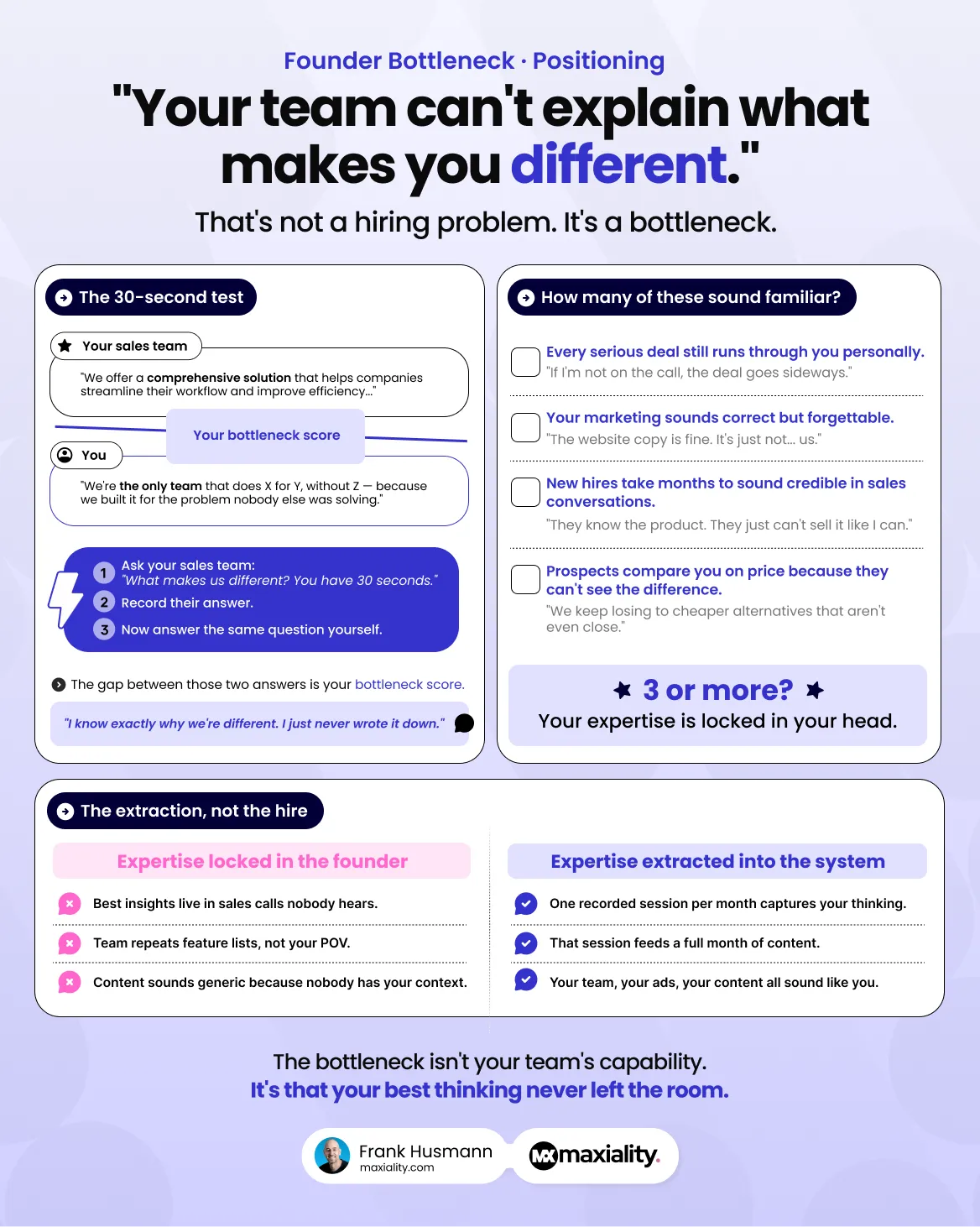
The 30-second test
I run this with almost every founder I start working with. It takes five minutes, and you don’t need me for it.
- Ask someone on your sales team: “What makes us different? You have 30 seconds.”
- Record their answer.
- Answer the same question yourself, also in 30 seconds.
Then put the two answers side by side. The gap between them is your bottleneck score.
A typical sales answer sounds like this: “We offer a comprehensive solution that helps companies streamline their workflow and improve efficiency.” Every competitor in your category could say that sentence. The founder’s answer usually sounds more like: “We’re the only team that does X for Y, without Z, because we built it for the problem nobody else was solving.”
When you compare them, look past the wording. Does your team name the same customer and the same problem you do, and do they give the reason a buyer should pick you over the obvious alternative? If they get the product right and the reason wrong, the gap is big, however polished their answer sounds.
Most founders I work with score high. That’s rarely the team’s fault. When I ask why the difference never made it to the team, I almost always hear some version of this: “I know exactly why we’re different. I just never wrote it down.”
Four symptoms
You don’t need the test to know something’s off. These four show up in almost every company I see at this stage, usually somewhere between €500K and €2M ARR:
- Every serious deal still runs through you personally. “If I’m not on the call, the deal goes sideways.”
- Your marketing sounds correct but forgettable. “The website copy is fine. It’s just not… us.”
- New hires take months to sound credible in sales conversations. “They know the product. They just can’t sell it like I can.”
- Prospects compare you on price, because they can’t see the difference. “We keep losing to cheaper alternatives that aren’t even close.”
One of these on its own can be a phase. Three or more, and your expertise is locked in your head.
The channel doesn’t matter much, by the way. Referrals, LinkedIn, ads or outbound: in companies with this problem, every serious conversation ends up back at the founder’s calendar.
Why hiring rarely moves it
The reflex is to add people. I understand it, and I’ve watched it fail often enough to be blunt about why.
A junior marketer gets tactics without strategic direction, so they guess at what matters and come back to you for every piece of positioning. A content agency produces output that’s technically fine and sounds nothing like how you think, because they’ve never heard you on a sales call.
Neither is a bad decision in itself. They just start one step too late. Both depend on thinking that’s still sitting in your head, and nobody can execute on a position they’ve never heard. What to install before you hire is in your first marketer or an agency.
What extraction looks like
The fix is a routine, and a small one. Once a month, someone sits down with the founder for a recorded session, run like an interview rather than a brainstorm. The questions go after what you already say on good sales calls, like the framing that makes a prospect lean forward or the objection you’ve answered fifty times.
That one session feeds a month of content: posts, articles, video clips, ad copy, and the lines your sales team uses in their own conversations. After a few months your team and your ads start to sound like you. They’re built from what you said, so they can’t really sound like anyone else.
| Expertise locked in the founder | Expertise extracted into the system |
|---|---|
| Your best insights live in sales calls nobody else hears | One recorded session a month captures your thinking |
| The team repeats feature lists, not your point of view | That session feeds a full month of content |
| Content sounds generic because nobody has your context | Your team, ads and content all sound like you |
It doesn’t take long to see whether it works. Robert Verkade, CRO at StoryChief, had two demo requests within the first ten days of posting the video clips we cut from one founder interview (the StoryChief case). Ivar van Duuren, co-founder of ISOPlanner, put it more simply: “I am very happy with the huge amount of content you guys can create, based on a 1 hour interview.”
Founder-led isn’t the problem
“You’re the bottleneck” can sound like “step back from sales”. That’s not the advice.
Kyle Poyar and Maja Voje’s 2026 State of B2B GTM report, a survey of 300 software GTM leaders, found that founder-led sales is the leading GTM motion up to $1M ARR (44% of respondents) and still the second most common between $1M and $10M ARR (26%). The same report notes that growth tends to slow when nothing more repeatable gets layered on top.
That matches what I see. Your involvement is what got you here. What runs out is a company where that involvement only happens when you’re physically in the room. More on the motion itself in what founder-led marketing is and why sales-led growth stalls.
FAQ
Should I hire a Head of Marketing to fix the founder bottleneck?
Not as the first move. A Head of Marketing can run a system, but in this situation they inherit the same gap your sales team has: they need your positioning before they can do anything with it. Get the thinking out first. Then a hire has something to work from instead of waiting on you.
How much of the founder’s time does extraction take?
One recorded session of about an hour a month, plus a short review of what comes out of it. Most of what gets captured is what you already say on sales calls, so there’s little to prepare.
Can’t I just write a sales playbook myself?
You can, and some founders do it well. In practice it tends to stall for two reasons. Writing down your own positioning is harder than saying it out loud to someone who asks good follow-up questions, and a document doesn’t reach prospects. A playbook helps your team. It doesn’t help a buyer who’s researching you before they ever book a call.
How do I know the bottleneck is shrinking?
Run the 30-second test again after three months and compare. The other signals show up in sales: prospects who mention your content on the first call, and deals your team closes without you. Fewer conversations drifting to price is usually the last one to appear.
Next step
If the test showed a big gap, the next question is where it costs you most, in your positioning or in the way sales follows up. The GTM Signal Audit gives you a first read in a few minutes. If you’d rather talk it through, book a call.