


Building authority as a B2B SaaS founder takes longer than most founders expect. The first six months feel flat, and compounding only starts around month 12. Being on most shortlists in your niche before the search starts takes closer to two years. The most common mistake comes early: founders quit around month 3, which is exactly where the curve looks flattest.
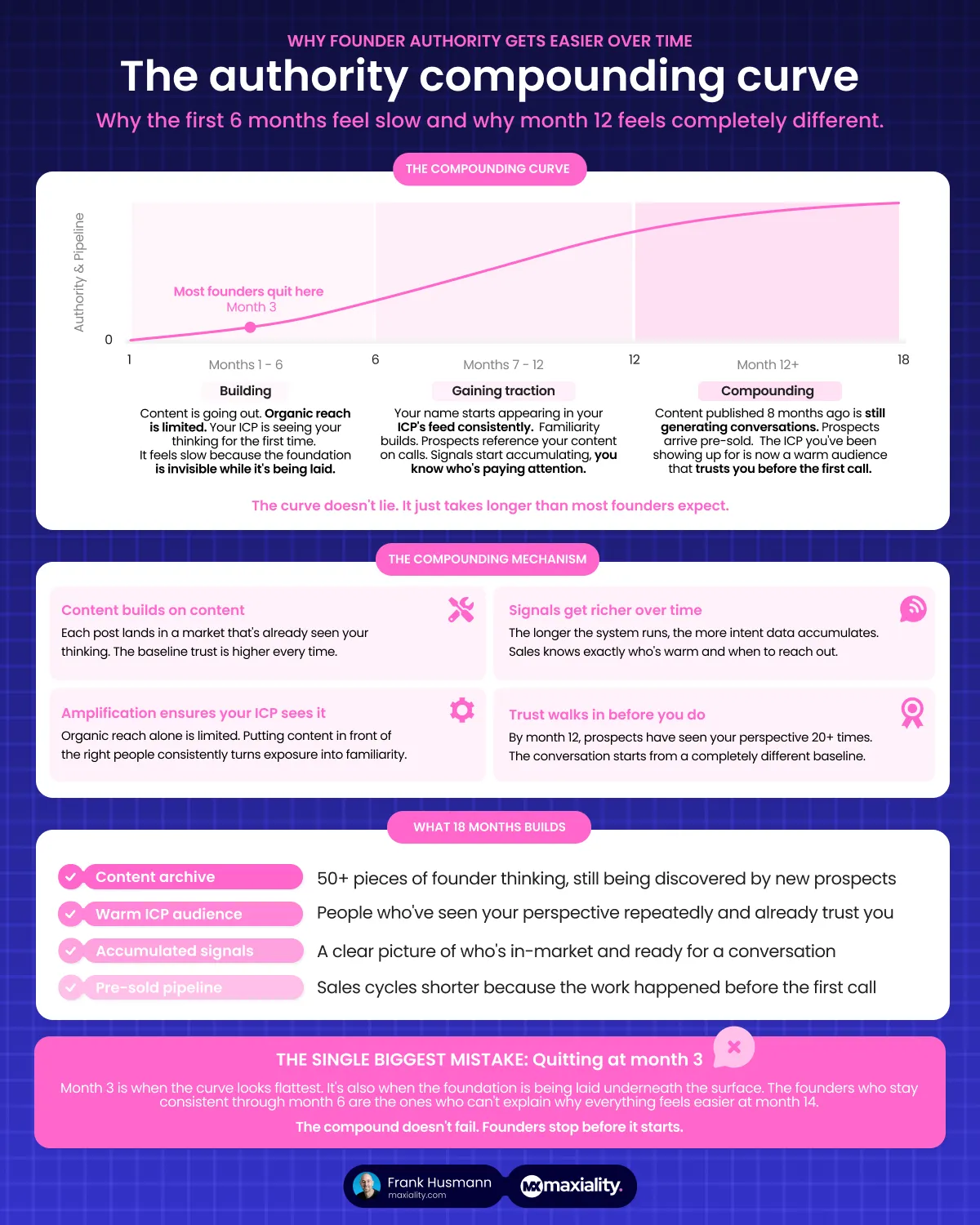
Why month 3 feels like failure
A founder called me three months into his content program because he wanted to stop. “Frank, we’re putting out solid posts. Nothing’s moving in pipeline.” I asked him to give it six more months.
I’ve watched the same moment across more than forty companies. At month 3 engagement is modest and pipeline hasn’t moved, so the obvious conclusion is that the channel doesn’t work. What’s really happening is the opposite: the foundation is being laid where you can’t see it yet.
The curve, phase by phase
Months 1 to 6: building. Content goes out and your ICP sees your thinking for the first time. Organic reach is limited and nothing has accumulated yet. It feels slow because the part that matters is invisible while it’s being built.
Months 7 to 12: gaining traction. Your name keeps showing up in your ICP’s feed, and familiarity starts to build. Prospects mention your content on sales calls before you bring it up. If you track signals, you can now see which accounts are paying attention.
Month 12 and beyond: compounding. A post from eight months ago still starts conversations. Prospects arrive pre-sold, so the first sales call begins from a different baseline because the trust work already happened.
The founders who stay consistent through month 6 usually can’t explain why month 14 feels so much easier. That’s the compound doing its work.
The full timeline to known name
The curve covers the first 18 months. Becoming one of the two or three names buyers already know in your niche takes a bit longer. In the companies I work with, it tends to look like this:
| When | What happens |
|---|---|
| Month 1 | First recognition: someone in your ICP sees your name for the first time |
| Months 3 to 6 | Consistent engagement: they keep seeing you, and your point of view becomes familiar |
| Months 8 to 12 | Peer mentions: your name comes up in Slack groups and calls without you prompting it |
| Months 14 to 18 | Inbound starts: people reach out because they already know you |
| Month 24 | On most shortlists in your niche before the search starts |
That last row is what the shortlist threshold is about. Buyers rarely evaluate everyone; they shortlist the names they already know, and each niche has room for only a few of them.
What makes it compound
Four forces push the curve upward, and they reinforce each other.
Content builds on content. Each new post lands in a market that has already seen some of your thinking, so the baseline trust is a little higher every time.
Amplification makes sure your ICP sees it. Organic reach on its own is limited. Putting your content in front of the right accounts consistently, for example with Thought Leader Ads on LinkedIn, turns exposure into familiarity much faster.
Signals get richer over time. The longer the system runs, the more intent data accumulates, and sales knows who is warm and when to reach out.
Trust walks in before you do. By month 12, a prospect may have seen your perspective twenty or more times. The first conversation starts from a completely different place.
What 18 months builds
After a year and a half of consistent founder content, you own four things that a campaign can’t buy:
- A content archive: fifty or more pieces of founder thinking that new prospects keep discovering.
- A warm ICP audience: people who’ve seen your perspective repeatedly and already trust it.
- Accumulated signals: a clear picture of which accounts are in-market and ready for a conversation.
- A pre-sold pipeline: shorter sales cycles, because most of the persuading happened before the first call.
What waiting costs
Delay isn’t neutral, because your competitors are on the same curve. If one of them starts now and you start in a year, the gap looks roughly like this. By month 3 they’re showing up in your ICP’s feed. Around month 6 your sales cycles get longer, because prospects arrive knowing less about you than about them. By month 9 they own the conversation in your niche, and you’re still explaining what you do.
The founder who starts now compounds from day one. The founder who waits twelve months starts from zero in a noisier market, and spends the first year closing a gap just to reach parity. That’s also why hiring a marketer at month 12 rarely rescues it: without a system to hand over, they start from zero too (more in your first marketer or an agency).
FAQ
How long does it take for founder content to generate pipeline?
Expect the first signals, such as target accounts engaging or visiting, within the first few months, and real traction somewhere between month 7 and month 12. Inbound from people who already know you usually starts after a year. Ads can shorten the early phase, but they don’t replace the consistency.
Why does it feel like nothing is working in the first months?
Because the results that matter don’t show up in pipeline yet. Your ICP is forming an impression and mentioning you to peers, and almost none of that is visible in a CRM. That’s why tracking signals early helps: it shows movement before revenue does.
How much content do you need?
The archive behind the curve is fifty or more pieces over eighteen months, so roughly three a month. Consistency matters more than volume. A few sharp posts a month with the same clear point of view beat a burst of daily posting that stops after six weeks.
Is it too late to start if competitors already post consistently?
No, but it gets harder every month. Each niche has room for a few known names, and the earlier ones compound faster. Starting with a sharper point of view than theirs is the best way to close the gap.
Next step
If you’re three months in and wondering whether to stop, or still waiting for the right moment to start, the GTM Signal Audit shows where you stand in a few minutes. If you’d rather talk it through, book a call.