


When the same sales objections keep coming back after you’ve rewritten the script, the script isn’t the problem. Recurring objections mean buyers are arriving confused, and that confusion forms long before the sales call. It starts with positioning, and that’s where it has to be fixed.
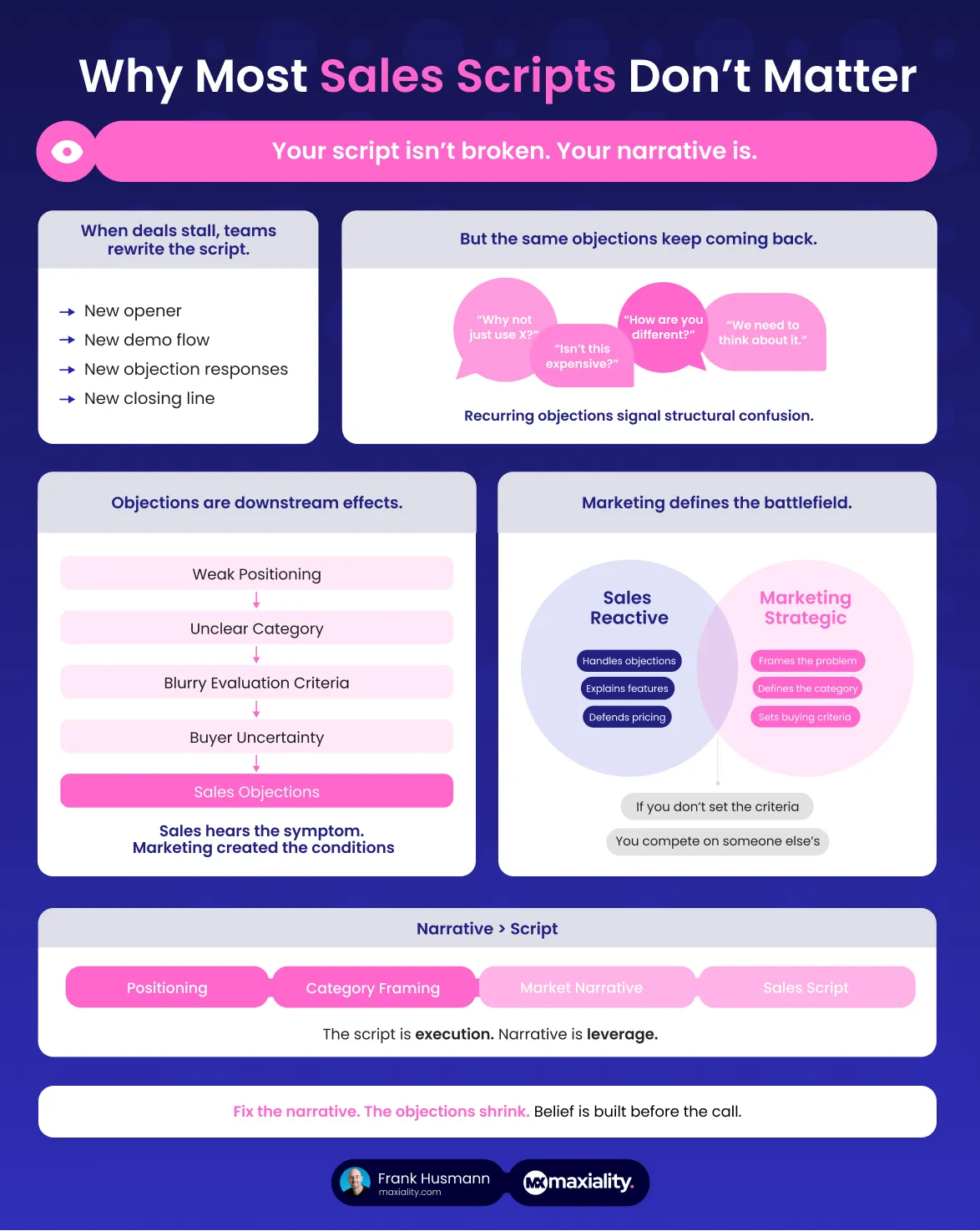
Same objections, different script
I reviewed a sales process for a SaaS founder who had the same four objections three months apart, under two different scripts:
- “Why not just use X?”
- “How are you different?”
- “This feels expensive.”
- “We need to think about it.”
In between, the team had rewritten the opener, updated the objection handling and adjusted the demo flow. The objections came back anyway.
That’s the usual reflex when deals stall: a new opener, a new demo flow, new objection responses, a new closing line. Each rewrite feels productive. None of it touches the reason buyers arrive with those questions in the first place.
Objections are downstream effects
Objections are the last link in a chain that starts well before the call:
- Weak positioning makes it unclear what you are and who you’re for.
- That leads to an unclear category: buyers don’t know what to compare you with.
- Which leads to blurry evaluation criteria: they don’t know what good looks like.
- Which creates buyer uncertainty.
- And that uncertainty shows up on your calls as sales objections.
Sales hears the symptom. Marketing created the conditions, usually by leaving the first three links to chance.
Read the four objections from that founder again, and you can see where each one comes from:
| The objection | What it usually signals |
|---|---|
| “Why not just use X?” | The buyer put you in the wrong category, next to the wrong alternative |
| “How are you different?” | Your positioning hasn’t reached them, or it sounds like everyone else’s |
| “This feels expensive.” | Someone else set the evaluation criteria, so you’re judged on price |
| “We need to think about it.” | Uncertainty nobody resolved, which often ends in lost to do nothing |
Marketing defines the battlefield
Sales is reactive by design. It handles objections, explains features and defends pricing, always in response to what the buyer brings into the room.
Marketing can work upstream of that. It can frame the problem, define the category and set the buying criteria before a prospect ever picks up the phone. If you don’t set those criteria, the buyer still uses some, and they come from a competitor or a peer. Then you’re competing on someone else’s terms, and your sales team plays catch-up on every call.
That’s why the order matters:
| Level | What it decides |
|---|---|
| Positioning | What you are, who it’s for and why it matters |
| Category framing | What buyers compare you with |
| Market narrative | The story buyers meet before they talk to you |
| Sales script | How the conversation runs once they do |
The script is execution and the narrative is leverage. Fix the narrative and the objections shrink, because belief gets built before the call.
The objection they say out loud is rarely the real one
I see the same pattern in my own sales. Three objections come up before almost every founder decides to work with me, and almost nobody says them directly.
Founders don’t ask “is this just LinkedIn posting?” They ask about deliverables and deadlines. They don’t ask whether it will create pipeline; they ask about timelines and results. And instead of asking whether I’m senior enough, they ask about my background.
So I answer the real question, not the one they asked: it’s not LinkedIn posting but GTM system design, the results run through authority, signals and pipeline in that order, and the experience is pattern recognition from more than forty companies. Each of those answers is a piece of positioning. The better our content makes those points before the first call, the less often the questions come up at all.
Your buyers do the same. Listen to what they keep asking about, not only to the words they use, and you’ll find the objection that’s really stalling the deal.
How to find and fix your real objections
- Collect them. Go through the notes or recordings of your last ten to twenty sales calls and write down every objection, word for word.
- Group them. Most companies end up with three to five recurring objections. Count how often each appears.
- Trace each one up the chain. Is it about the category you are in, or about the criteria buyers use? The table above is a starting point.
- Fix it upstream. Answer the underlying question in your content, before the call: frame the problem, name the category, publish the criteria you want buyers to use. A sharp positioning sentence helps here; the template is in the 3 phases of founder-led GTM.
- Check again in a quarter. If the same objections come up less often, the narrative is reaching buyers before sales does.
This is also how you get onto the shortlist instead of into the comparison: buyers who already understand your category and your criteria arrive above the shortlist threshold.
FAQ
Are recurring objections a sales problem or a marketing problem?
Mostly a marketing problem that shows up in sales. Sales hears the objection, but the confusion behind it comes from positioning, category and evaluation criteria, which are set before the call. If the same objections survive several scripts and several reps, look upstream.
Should we still train objection handling?
Yes. Good objection handling saves deals that are already in the pipeline. It treats the symptom, though, so it works best alongside a narrative that stops the same objections from forming in the first place.
How do I know it’s a positioning problem and not a bad rep?
When the same objections survive a new script and show up with every rep, it’s structural. A rep problem looks different: one person’s deals stall while others close with the same story.
How long before objections start to drop?
It depends on how quickly your narrative reaches buyers before the call. With consistent content aimed at your ICP, most companies notice a change within a few months, first in the questions prospects ask on the first call.
Next step
Write down the objections from your last ten calls and trace each one up the chain. For a broader read on where your go-to-market stands, the GTM Signal Audit takes a few minutes. If you’d rather go through it together, book a call.