


Founder-led go-to-market tends to move through three phases. In phase 1 your ICP doesn’t know you exist. In phase 2 they’ve seen your name but haven’t bought into your thinking, and in phase 3 they seek you out and arrive pre-sold. Most B2B SaaS founders I talk to are in phase 1 or 2 without knowing it, and they treat it as a marketing problem when it’s really a phase problem.
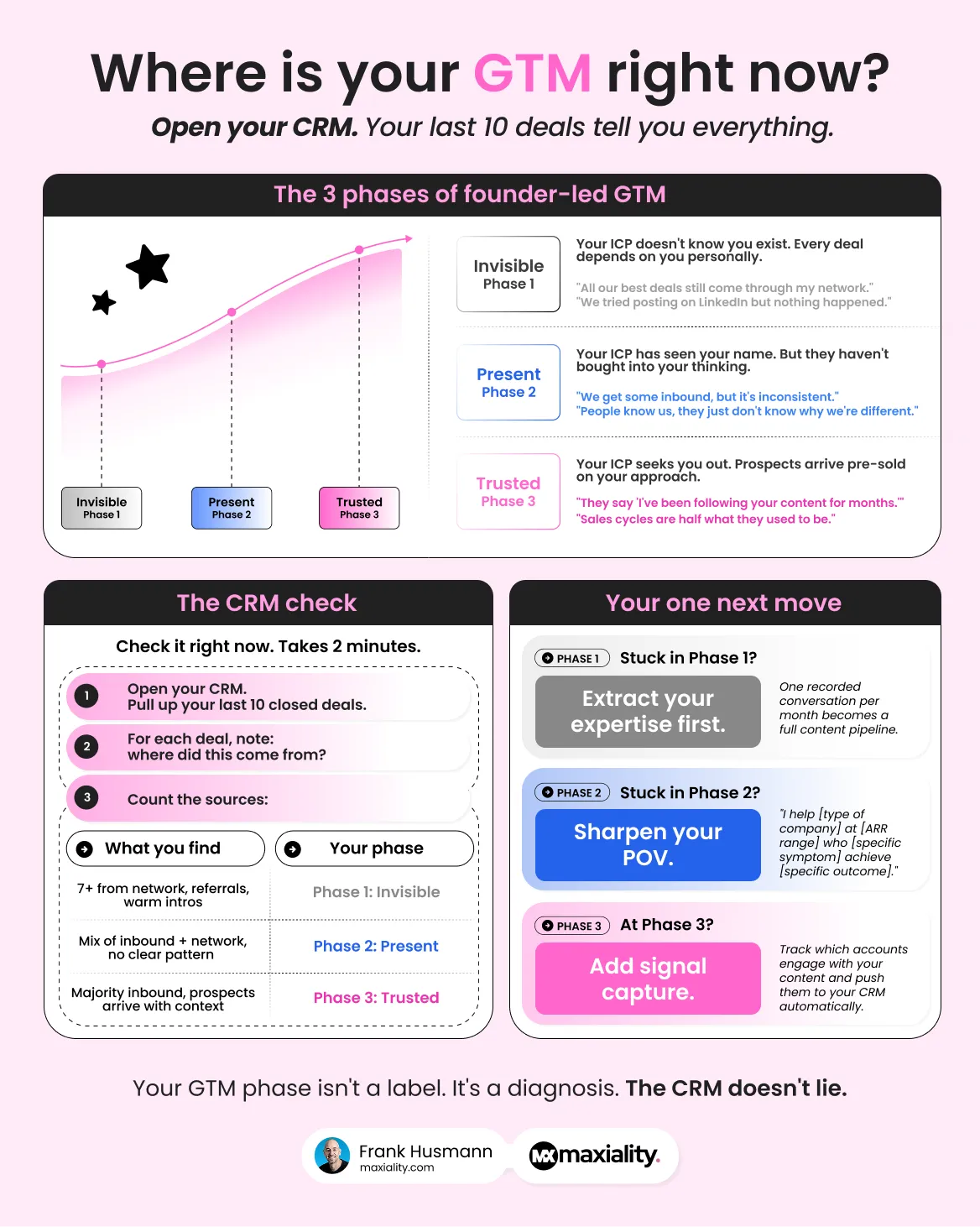
The three phases
Phase 1: Invisible. Your ICP doesn’t know you exist. Every deal comes through your personal network, prospects need everything explained from scratch, and you’re the only one who can close properly. Founders here say things like “all our best deals still come through my network”, or “we tried posting on LinkedIn but nothing happened”. This is where most founders are, and most of them don’t realise it.
Phase 2: Present. Your ICP has seen your name, and some inbound is starting. Prospects occasionally say “I’ve seen your posts”, but they haven’t bought into your thinking yet. You’re somewhere in their consideration set without being the obvious choice. The sales cycle is still long and most deals still need you. This is where founders land after they start showing up consistently without a system behind it.
Phase 3: Trusted. Your ICP seeks you out. Prospects reference your content before the first call, and your sales team closes deals you were never part of. A post from six months ago is still starting conversations. The second infographic below calls this phase magnetic; it’s the same phase. This is where founder-led GTM starts to compound.
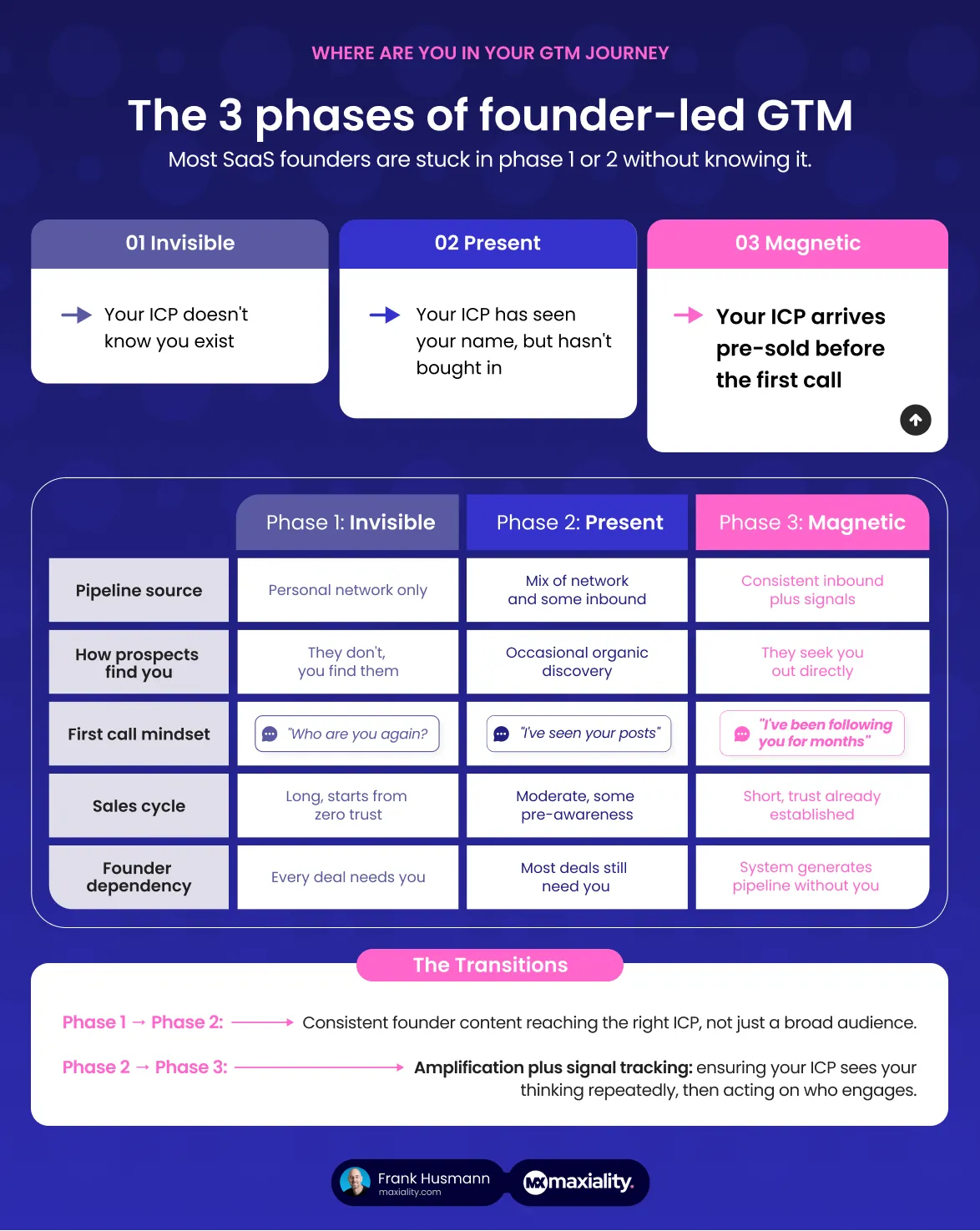
Side by side, the differences show up in five places:
| 1. Invisible | 2. Present | 3. Trusted | |
|---|---|---|---|
| Pipeline | Network only | Network, some inbound | Inbound and signals |
| Discovery | You find them | Now and then | They find you |
| First call | “Who are you?” | “Seen your posts” | “Following you for months” |
| Sales cycle | Long | Moderate | Short |
| Founder needed | Every deal | Most deals | Rarely |
The 2-minute CRM check
Most founders misread which phase they’re in. Activity on LinkedIn feels like progress, and a few inbound leads feel like phase 3. Your CRM gives a more honest answer, and it takes about two minutes:
- Open your CRM and pull up your last ten closed deals.
- For each deal, note where it actually came from.
- Count the sources.
| What you find | Your phase |
|---|---|
| Seven or more from your network, referrals or warm intros | Phase 1: Invisible |
| A mix of inbound and network, no clear pattern | Phase 2: Present |
| Mostly inbound, with prospects arriving with context | Phase 3: Trusted |
Seven out of ten from your network feels like a good sign, because those deals close. It usually means the market doesn’t know you yet and every deal still runs through you. That’s the founder bottleneck showing up in your data.
One move per phase
Each phase gets one move, not five. Trying to do everything at once is how founders end up with a lot of activity and no shift in where deals come from.
Stuck in phase 1: extract your expertise first. Your best thinking already exists, in sales calls and customer conversations, but nobody outside the deal hears it. One recorded conversation a month can feed a full content pipeline.
Stuck in phase 2: sharpen your point of view. People know your name but not why you’re different, and in sales that gap tends to show up as the same objections on every call. Fill in this sentence and make every piece of content prove it: “I help [type of company] at [ARR range] who [specific symptom] achieve [specific outcome].”
At phase 3: add signal capture. Track which accounts engage with your content and push them into your CRM automatically, so sales talks to warm accounts instead of waiting for form fills. How that works is in the invisible B2B buying journey.
How you move between phases
Getting from phase 1 to phase 2 is mostly about consistency. Show up with a point of view, aimed at your actual ICP rather than a broad audience, and keep showing up.
Getting from phase 2 to phase 3 is about a system. Your ICP has to see your thinking repeatedly, which usually takes amplification such as Thought Leader Ads on LinkedIn, and you have to act on who engages. Neither step is fast. The month-by-month version is in how long founder authority takes.
FAQ
What is founder-led GTM?
It’s a go-to-market approach where the founder’s expertise and point of view drive how the market gets to know the company, mainly through content, and a system turns that attention into pipeline. It’s different from founder-led sales, where the founder personally closes every deal.
Is phase 1 bad?
No. Almost every B2B SaaS company starts there, and a strong network is how most reach their first customers. It becomes a problem when growth depends on it, usually somewhere around the €1M ARR wall, because your network runs out and your calendar doesn’t grow.
Why can’t I skip phase 2?
Because trust builds in that order. Your ICP has to see your name before they can buy into your thinking, and they have to buy into your thinking before they arrive pre-sold. Ads can speed up phase 2, but they can’t replace it.
How often should I run the CRM check?
Every quarter is enough. The pattern in your last ten deals moves slowly, and checking it more often mostly shows noise.
Next step
Run the CRM check on your last ten deals and see which phase comes out. For a broader read on where your go-to-market stands, the GTM Signal Audit takes a few minutes. If you’d rather go through it together, book a call.