


Rising CAC in B2B SaaS is rarely an ad problem. Same budget, half the results, and the obvious move is to blame the channel. In the companies I map, the cause sits underneath the spend: there’s nothing buyers trust before the first impression lands, so paid has to create demand from cold and convert it in the same breath. That’s an expensive job to give an ad account.
The paid channel squeeze
Part of the rise is structural, and it gets worse every year. More SaaS companies means more competition for the same ad inventory. That pushes up cost per click, while buyers who see more ads than ever convert at lower rates. Higher CPCs times lower conversion rates is higher CAC, whatever you do with the creative. Most of that competition is for the same small group of buyers who are in market right now, which is the hidden cost of performance marketing.
You can’t fix that from inside the ad account. What you can change is how much work the ads have to do on their own.
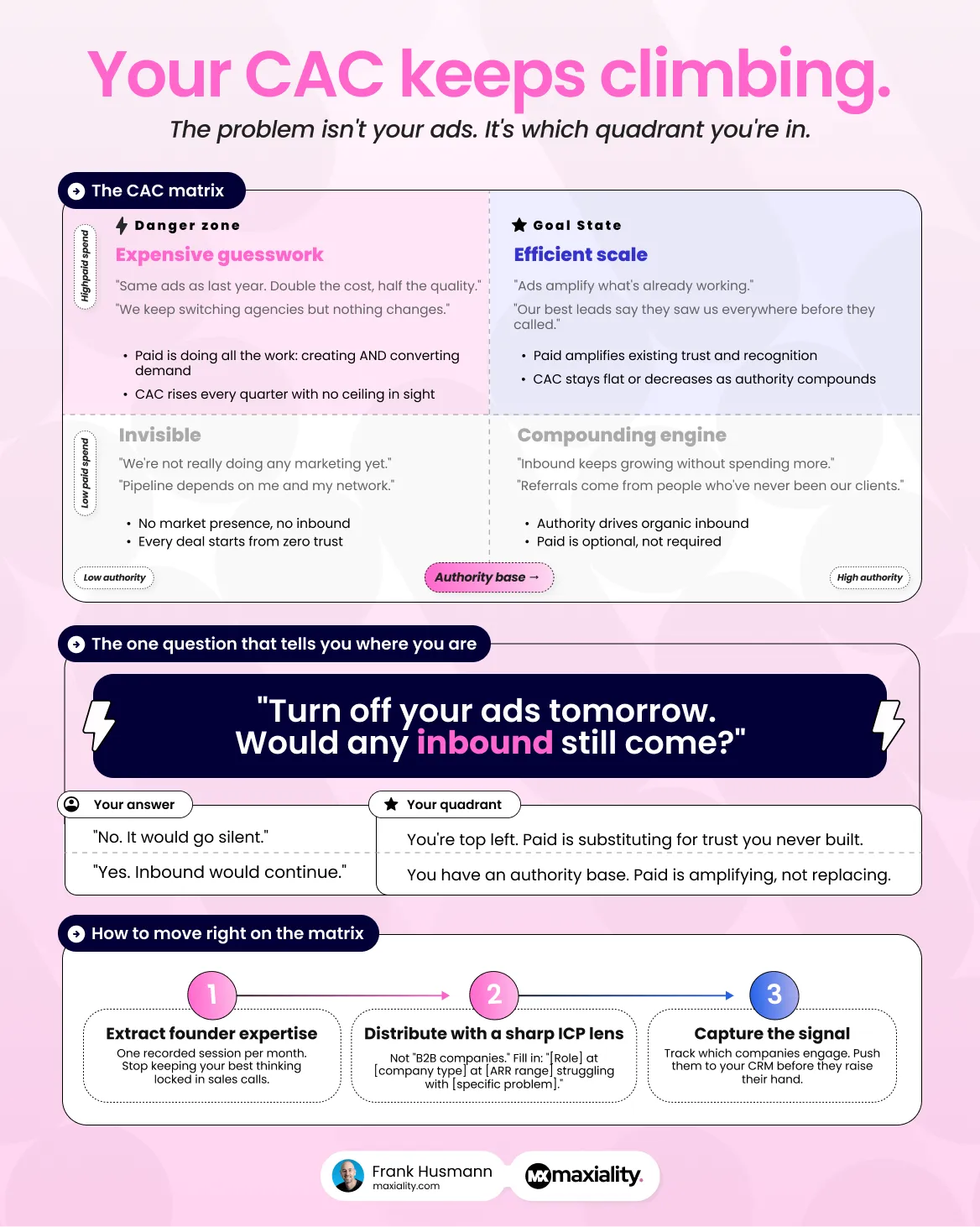
The CAC matrix: paid spend vs. authority
I’ve mapped more than forty B2B SaaS companies onto two axes: how much they spend on paid, and how much authority they’ve built with their ICP. Most of them end up in the same quadrant.
| Low authority | High authority | |
|---|---|---|
| High paid spend | Expensive guesswork. Paid creates and converts demand on its own. CAC rises every quarter. | Efficient scale. Paid amplifies trust you already built. CAC stays flat or drops. |
| Low paid spend | Invisible. No presence and no inbound. Every deal starts from zero trust. | Compounding engine. Inbound grows without more spend. Paid is optional. |
Expensive guesswork is the danger zone, and the most common one. Founders here say “same ads as last year, double the cost, half the quality”, or “we keep switching agencies but nothing changes”. You’re renting attention you don’t own.
Efficient scale is the goal. Ads amplify what’s already working, and the best leads say they saw you everywhere before they called.
Invisible is the quiet quadrant: not much marketing yet, and pipeline depends on the founder and their network. If that’s you, the 3 phases of founder-led GTM is the better place to start.
Compounding engine is where inbound keeps growing without spending more, and referrals come from people who’ve never been customers.
The one question that tells you where you are
Ask yourself this: if you turned off your ads tomorrow, would any inbound still come?
If the honest answer is “no, it would go silent”, you’re top left. Paid is substituting for trust you never built, which is why every extra euro buys a little less. If inbound would continue, you have an authority base, and paid is amplifying it instead of replacing it.
Two companies, same budget, 24 months
Picture two companies with the same starting budget. One runs paid only. The other builds an authority base alongside paid.
For the first, CAC climbs from month 6 to month 12 to month 24, because every quarter it pays more to reach buyers who have never heard of it. For the second, CAC starts higher and then falls, because each month more of the market already knows the company before an ad reaches them. I’ve seen this diverge across enough companies that it’s not a theory anymore; by month 24 their CAC looks nothing alike. How that compounding works month by month is in how long founder authority takes.
What most founders do when CAC rises
The usual response is a loop: more budget, then a new channel, then a new agency. Each step feels like action, and each ends with the same result, because more spend on a broken system just costs more. The channel was never the problem. The same pattern shows up when founders hire before the system exists, covered in your first marketer or an agency.
Ads need time, and a calendar check
Part of rising CAC is impatience. B2B buyers don’t convert on the third click; they convert after months of seeing you show up.

We pulled this from our own intent-signal data for one of our SaaS clients. For the deals that closed, it took on average 53 LinkedIn ad clicks and 261 days from the company’s first click to the won deal. That’s one account and a small sample of eight deals, so read it as an illustration rather than a benchmark. It does show why judging a campaign after six weeks tells you very little. Most founders would have switched that campaign off months before the deal appeared in the CRM.
If your ads “aren’t working” after six weeks, check the calendar before you check the creative.
How to move right on the matrix
Moving right doesn’t mean spending less. It means building something the spend can amplify instead of carrying everything alone. Three moves get you there:
- Extract founder expertise. One recorded session a month is enough to stop your best thinking from staying locked in sales calls nobody outside the deal hears.
- Distribute it with a sharp ICP lens. Not “B2B companies”, but a specific buyer: “[role] at [company type] at [ARR range] struggling with [specific problem]”.
- Capture the signal. Track which companies engage, and push them to your CRM before they raise their hand.
Founder authority plus consistent ICP content plus intent signals gives you buyers who arrive pre-sold. When they do, paid spend amplifies instead of substituting.
FAQ
Why does CAC keep rising in B2B SaaS?
Partly because paid channels get more crowded every year, which raises costs and lowers conversion rates. The bigger reason is usually that paid is doing all the work: creating demand from cold and converting it. Without an authority base underneath, every new customer costs a little more than the last.
Should I cut my ad spend if CAC is too high?
Not as a first move. Cutting spend in the expensive-guesswork quadrant usually lands you in the invisible quadrant, with fewer leads and the same underlying problem. Build the authority base first, then judge which spend is amplifying it.
How long before CAC starts to come down?
Expect months rather than weeks. Authority usually starts to compound somewhere after month 6, and the effect on CAC becomes clear in the second year. The founders who see it are the ones who keep going through the flat early months.
Are LinkedIn Ads worth it for B2B SaaS?
They work best as amplification: putting the founder’s thinking in front of the right accounts repeatedly, for example with Thought Leader Ads. As the only source of demand, with nothing underneath, they’re the most expensive way to fill a pipeline.
Next step
Ask yourself the one question: if you turned off your ads tomorrow, what would still come in? For a broader read on where your spend and authority stand, the GTM Signal Audit takes a few minutes. If you’d rather go through it together, book a call.