

At any given moment, only a small share of your market is actually buying. The usual rule of thumb is around 5%. Most B2B paid campaigns are pure demand capture, so they all compete for that same small group of buyers who are searching right now. The other 95% will buy later, and they decide who to call based on what they read and believed in the months before they ever opened a search bar.
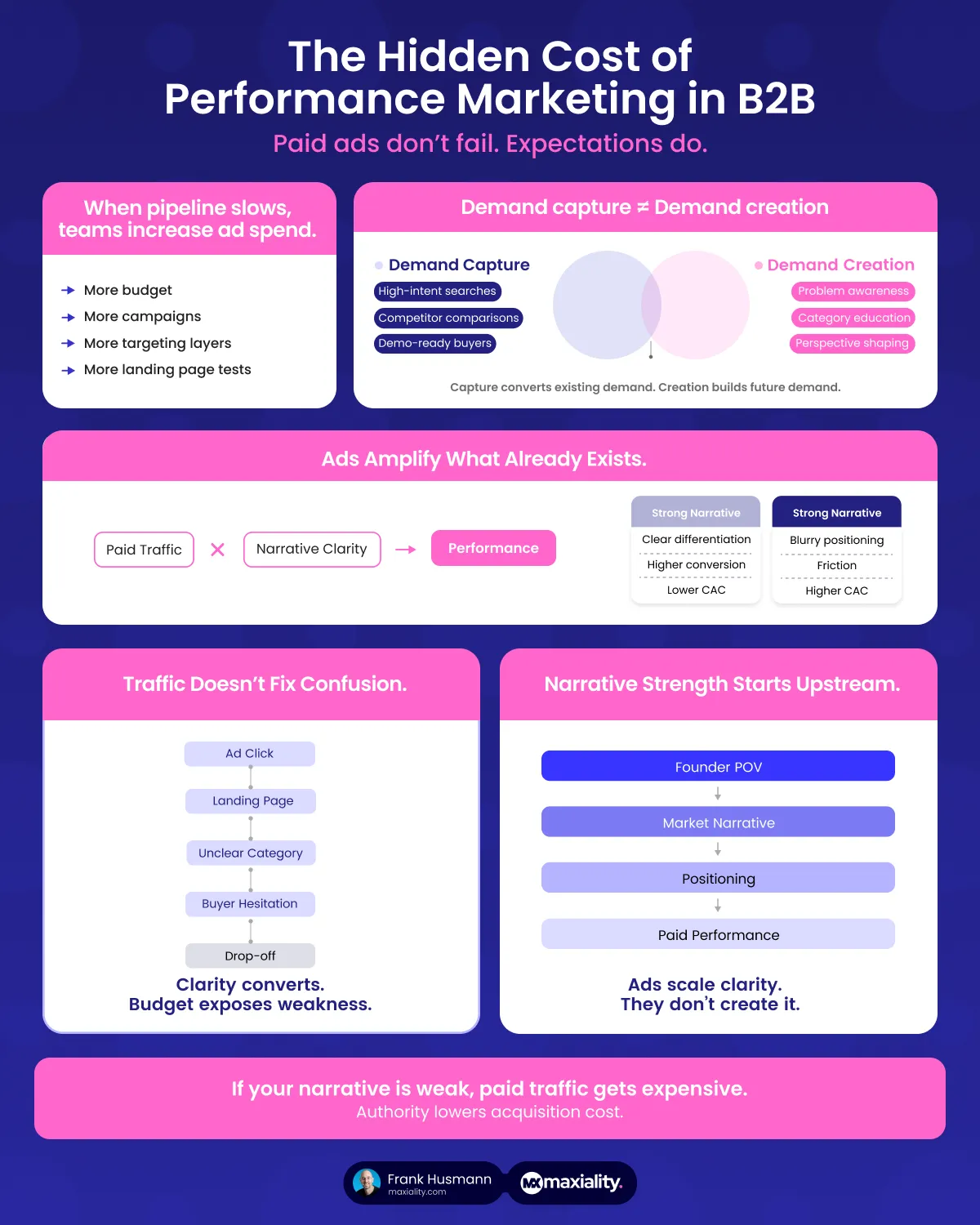
When pipeline slows, teams buy more of the same
The reflex is predictable: more budget, more campaigns, more targeting layers, more landing page tests. I once had this exact conversation with three founders in a single month. In each case the spend went up and the results didn’t.
The ads weren’t the problem. What the ads were pointing at was.
Demand capture is not demand creation
Paid marketing does two very different jobs, and most B2B budgets only fund one of them.
| Demand capture | Demand creation | |
|---|---|---|
| Who it reaches | Buyers already looking | Buyers who will look later |
| Typical form | High-intent search, competitor comparisons, demo offers | Problem awareness, category education, a clear point of view |
| What it does | Converts existing demand | Builds future demand |
| Share of the market | Small, roughly 5% at any time | The large majority |
Capture works, and you need it. The trouble starts when it’s the only thing you do, because then you’re fishing in the same small pond as every competitor.
Why chasing the 5% gets expensive
The 95:5 rule comes from marketing scientist John Dawes of the Ehrenberg-Bass Institute, published by LinkedIn’s B2B Institute in 2021: at any moment about 5% of B2B buyers are in market, and the other 95% aren’t buying yet. Dawes himself calls the 95% figure a rule of thumb rather than a precise number, and intent-data vendors argue more buyers show in-market behaviour than that. The direction holds either way: the group that’s ready to buy today is small, and everyone bids on it.
That’s part of why CAC keeps climbing. More companies compete for the same in-market buyers, so clicks get more expensive, while the buyers you could reach earlier are left to whoever is building their thinking now.
It also matches when decisions get made. Dreamdata’s 2026 benchmark, based on tracked deal journeys, found that 81% of the research phase happens before sales gets involved. A campaign that only shows up at the search bar arrives after most of that research is done. How that hidden phase works is in the invisible B2B buying journey.
Ads amplify what already exists
Think of paid performance as paid traffic multiplied by narrative clarity. Strong narrative, and the same budget gives you clear differentiation, higher conversion and a lower CAC. Weak narrative, and it gives you blurry positioning, friction and a higher CAC.
You can see where it breaks in a typical click path. Someone clicks the ad and lands on the page. They can’t quite place what category you’re in, so they hesitate, and then they leave. More traffic only sends more people down that same path. Clarity converts, while extra budget mostly exposes the weakness faster. The same confusion shows up later in sales as recurring objections.
Narrative strength starts upstream
Paid performance sits at the end of a chain:
- Founder point of view: what you believe about the problem that others in your market don’t say.
- Market narrative: the story buyers meet before they talk to you.
- Positioning: what you are, and why that matters to one specific buyer.
- Paid performance: the ads that put all of that in front of the right people.
Ads scale clarity. They don’t create it. If the first three links are weak, paid traffic gets expensive no matter how good the targeting is.
Where to put your budget instead
You don’t have to stop capturing demand. Keep the campaigns that reach buyers who are searching right now. What changes is that part of the paid budget goes to the 95%:
- Put the founder’s thinking in front of target accounts before they search. Thought Leader Ads on LinkedIn do this well, because they carry a person’s point of view instead of a company’s offer.
- Judge creation on different numbers. Engagement from target accounts and visits to high-intent pages show progress long before a deal does.
- Give it time. For one of our clients, deals took on average 261 days and 53 ad clicks from the first click to the won deal. A campaign judged after six weeks never gets that far; more on that in why your CAC keeps climbing.
Authority lowers acquisition cost, and ads scale it.
FAQ
What is the 95:5 rule in B2B marketing?
It’s the idea that at any given moment only about 5% of B2B buyers are in market for what you sell, while 95% aren’t buying yet but will be later. It comes from John Dawes of the Ehrenberg-Bass Institute and was published by LinkedIn’s B2B Institute. It’s a rule of thumb, not a measured percentage, and the real share varies by category.
Is performance marketing a waste for B2B SaaS?
No. Capturing buyers who are already searching is valuable and usually converts well. It becomes a problem when it’s the whole strategy, because you’re then competing with every other vendor for a small group of buyers, and your cost per customer rises every year.
How do you reach the 95% who aren’t buying yet?
With content that shapes how they think about the problem before they need a solution, put in front of the right accounts often enough to be remembered. For most founder-led SaaS companies that means founder content on LinkedIn, amplified with Thought Leader Ads aimed at the ICP.
How do you measure demand creation if it doesn’t produce leads right away?
Look at leading indicators: which target accounts engage with your content or visit high-intent pages, and how many of them turn into conversations over the following months. Last-click attribution will undervalue it almost every time.
Next step
Check how much of your paid budget reaches buyers who aren’t searching yet. For a broader read on where your spend and authority stand, the GTM Signal Audit takes a few minutes. If you’d rather go through it together, book a call.